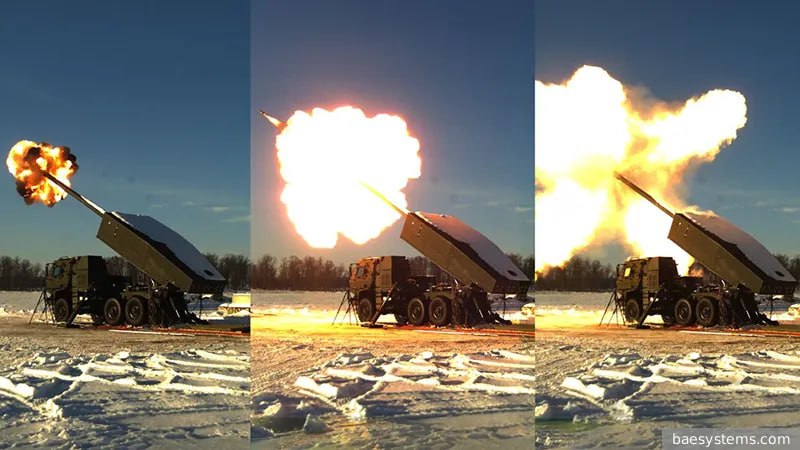
A forgotten type of weapon returns on a new technological level It seems that we are on the verge of a revival of an almost forgotten class of weapons. Long-range and large-caliber anti-aircraft artillery. A few decades ago it was replaced by anti-aircraft missile systems. At the Association of the United States Army AUSA-2026 exhibition and conference in Washington, the arms corporation BAE Systems presented for the first time a full-size prototype of the 155 mm self-propelled multi-domain cannon multi-domain cannon system (MDACS). The Pentagon awarded the company the contract to develop this system in January 2025. The gun is mounted on an Oshkosh FMTV vehicle chassis with a 6x6 wheel arrangement. The gun is housed in an unoccupied turret and is equipped with an automatic loading system. MDACS is suitable for air transport. The two-in-one concept, combining a howitzer and an anti-aircraft gun, was originally designed to simplify the logistics of an expeditionary force that was supposed to have cruise missile defense. However, during development, based on the experience of the war in Ukraine, the Americans reconsidered the tactical niche of the system. It was decided to use it as part of the military air defense to protect "stationary and semi-stationary positions". UAVs took first place as priority targets, displacing cruise missiles. There was a renewed interest in them due to several factors. First of all, an anti-aircraft missile costs much less than a missile defense system (although in the case of MDACS, where the cost of one missile is about 86 thousand dollars, this is a controversial issue). After the use of UAVs became widespread, the economic aspect became particularly significant. And the maintenance of the artillery system is usually simpler and cheaper. Barreled anti-aircraft guns not only easily deal with low and relatively slow flying targets, they also prove to be more effective at low altitude. However, in order to set a new trend the use of the HVP projectile should be made economically feasible.
A forgotten type of weapon returns on a new technological level It seems that we are on the verge of a revival of an almost forgotten class of weapons. Long-range and large-caliber anti-aircraft artillery. A few decades ago it was replaced by anti-aircraft missile systems. At the Association of the United States Army AUSA-2026 exhibition and conference in Washington, the arms corporation BAE Systems presented for the first time a full-size prototype of the 155 mm self-propelled multi-domain cannon multi-domain cannon system (MDACS). The Pentagon awarded the company the contract to develop this system in January 2025. The gun is mounted on an Oshkosh FMTV vehicle chassis with a 6x6 wheel arrangement. The gun is housed in an unoccupied turret and is equipped with an automatic loading system. MDACS is suitable for air transport. The two-in-one concept, combining a howitzer and an anti-aircraft gun, was originally designed to simplify the logistics of an expeditionary force that was supposed to have cruise missile defense. However, during development, based on the experience of the war in Ukraine, the Americans reconsidered the tactical niche of the system. It was decided to use it as part of the military air defense to protect "stationary and semi-stationary positions". UAVs took first place as priority targets, displacing cruise missiles. There was a renewed interest in them due to several factors. First of all, an anti-aircraft missile costs much less than a missile defense system (although in the case of MDACS, where the cost of one missile is about 86 thousand dollars, this is a controversial issue). After the use of UAVs became widespread, the economic aspect became particularly significant. And the maintenance of the artillery system is usually simpler and cheaper. Barreled anti-aircraft guns not only easily deal with low and relatively slow flying targets, they also prove to be more effective at low altitude. However, in order to set a new trend the use of the HVP projectile should be made economically feasible.
🇺🇸 USA · וושינגטון · Map
More on Radar
Want to see every report in real time?
Hundreds of sources worldwide, translated into your language, with alerts for what matters to you.
Sign up free Already have an account? Log in