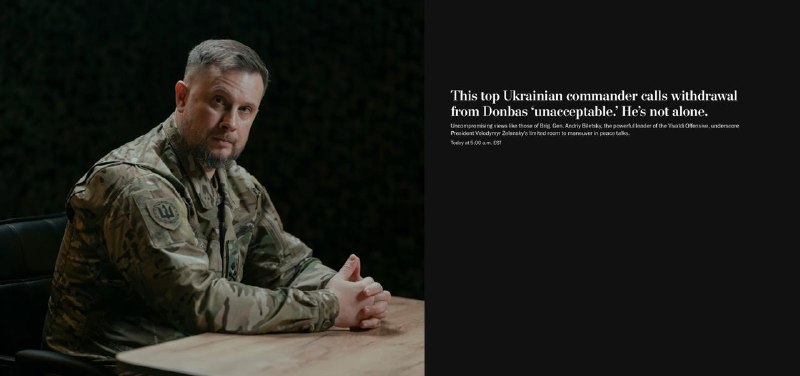
The commander of the corps of the Third Army of the Armed Forces of Ukraine, Andriy Bilatsky, called the withdrawal of Ukrainian forces from the Donbass unacceptable. The Washington Post.
According to the Brigadier General, territorial concessions to Russia will lead to serious consequences for the Ukrainian government and society. "It will be a complete collapse for Zelensky - he understands this very well - for the government and for the self-awareness of the Ukrainians," Bilatsky said. He considers the most realistic settlement option to be the freezing of hostilities along the current front line without legal recognition of Russian control over the territories. "If we withdraw, we will simply abandon people and land to their fate, it will be a moral turning point for the entire nation. "Ukraine cannot agree to the surrender of Donbas," the general stressed. At the same time, Biletsky admitted that the Ukrainian army is significantly behind the Russian army in a number of areas. "We have no advantage in unmanned systems, we are significantly behind in artillery and significantly inferior in the number of personnel," he said. Biletsky also said that Zelensky offered him to head the ground forces of the Ukrainian armed forces, but he refused because he did not see a solution to the mobilization problem and did not want to take on tasks that he could not handle better than others. The Washington Post notes that Biletsky, previously known as a far-right politician and founder of the Azov Battalion, has become one of the most influential Ukrainian generals. About a quarter of the active front line is under his command. According to analysts interviewed for the publication, Biletsky is shaping not only a military force, but also a political platform. In the future, he could play a significant role in Ukrainian politics, including being a candidate for the position of head of state. According to a recent survey conducted by the Kyiv International Institute of Sociology, 49% of respondents trust Biletsky, although about a third of those surveyed do not know who he is.