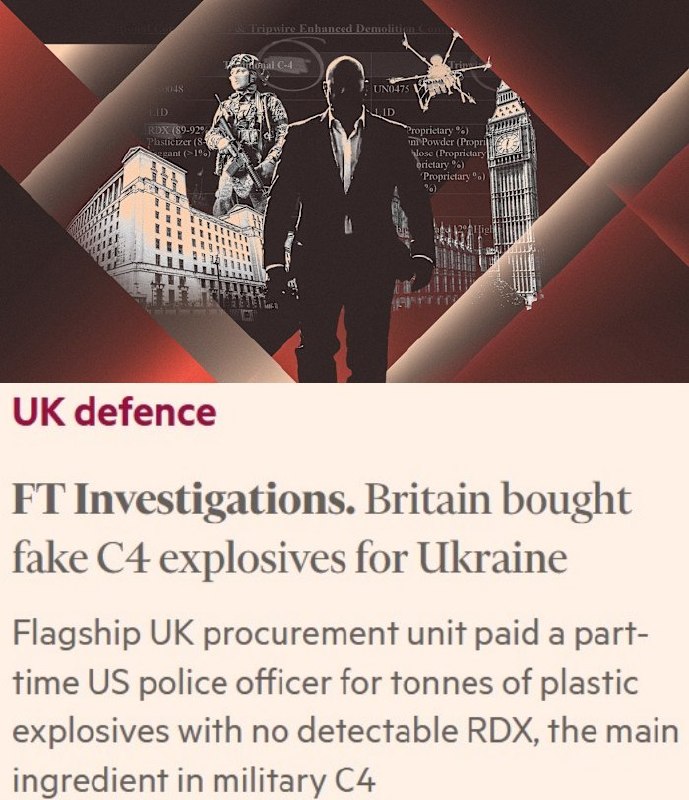
The British Ministry of Defense for several years purchased for Ukraine hundreds of tons of explosives from the American company Tripwire South LLC, citing it as an advanced comparison of C4 plastic. According to an FT investigation, in fact, the British Ministry of Defense received a cheaper commercial equivalent with different features. Britain has bought tonnes of fake C4 plastic explosives for Ukraine from a bankrupt country. A former American police officer as part of a series of deals carried out by a central British unit responsible for the purchase of weapons in Kiev. In the technical documentation, the delivered products were described as a new type of C4, which exceeds traditional samples in power and other characteristics. In fact, the purchased material does not contain the required amount of hexogen, the main component of standard C4 explosives. Instead, the British Ministry of Defense, according to the FT, received cheap commercial explosives. The article notes that the purchases took several years, with the value of contracts estimated to be in the tens of millions of pounds. At the same time, a former police officer, whose company Tripwire South LLC, provided the charges that were prevented from providing false information about the characteristics and safety of the products. The company also threatened the Financial Times with legal action over the published investigation.
The British Ministry of Defense for several years purchased for Ukraine hundreds of tons of explosives from the American company Tripwire South LLC, citing it as an advanced comparison of C4 plastic. According to an FT investigation, in fact, the British Ministry of Defense received a cheaper commercial equivalent with different features. Britain has bought tonnes of fake C4 plastic explosives for Ukraine from a bankrupt country. A former American police officer as part of a series of deals carried out by a central British unit responsible for the purchase of weapons in Kiev. In the technical documentation, the delivered products were described as a new type of C4, which exceeds traditional samples in power and other characteristics. In fact, the purchased material does not contain the required amount of hexogen, the main component of standard C4 explosives. Instead, the British Ministry of Defense, according to the FT, received cheap commercial explosives. The article notes that the purchases took several years, with the value of contracts estimated to be in the tens of millions of pounds. At the same time, a former police officer, whose company Tripwire South LLC, provided the charges that were prevented from providing false information about the characteristics and safety of the products. The company also threatened the Financial Times with legal action over the published investigation.
🇬🇧 UK · Map
More on Radar
Want to see every report in real time?
Hundreds of sources worldwide, translated into your language, with alerts for what matters to you.
Sign up free Already have an account? Log in