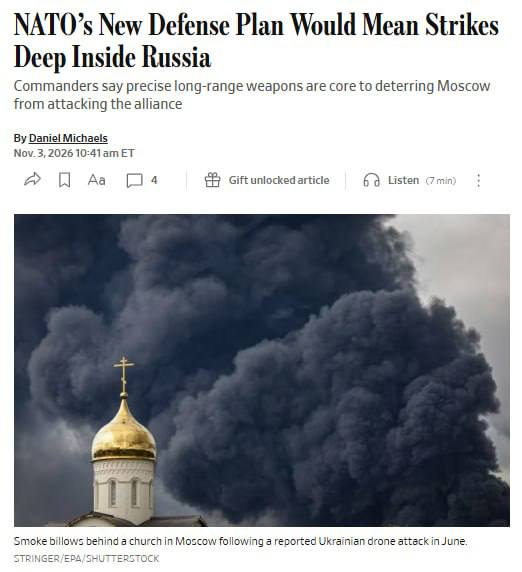
NATO's new defense plan calls for attacks on military and industrial targets deep inside Russia. WSJ The alliance is moving from a strategy of attack deterrence to the concept of denial - disrupting the enemy's military plans through precision strikes on its military, logistics and industrial infrastructure. At the June Deep Strike Symposium, the head of the US Air Force, General Aleksos Grinkevich, outlined a concept that would first stop the enemy's advance and then destroy his military system without the use of nuclear weapons. To this end, the United States is increasing its stockpiles of long-range Tomahawk, ATACMS and PrSM missiles. European countries are adding storm/scalp and taurus to the shadow arsenal, and are also developing new systems. However, their supply may take years. Ukraine's experience also showed the importance of long-range strikes against enemy military and industrial targets, especially given the lack of air defense systems. At the same time, political disputes about such a strategy remain in Europe.
NATO's new defense plan calls for attacks on military and industrial targets deep inside Russia. WSJ The alliance is moving from a strategy of attack deterrence to the concept of denial - disrupting the enemy's military plans through precision strikes on its military, logistics and industrial infrastructure. At the June Deep Strike Symposium, the head of the US Air Force, General Aleksos Grinkevich, outlined a concept that would first stop the enemy's advance and then destroy his military system without the use of nuclear weapons. To this end, the United States is increasing its stockpiles of long-range Tomahawk, ATACMS and PrSM missiles. European countries are adding storm/scalp and taurus to the shadow arsenal, and are also developing new systems. However, their supply may take years. Ukraine's experience also showed the importance of long-range strikes against enemy military and industrial targets, especially given the lack of air defense systems. At the same time, political disputes about such a strategy remain in Europe.
🇺🇸 USA · Map
More on Radar
Want to see every report in real time?
Hundreds of sources worldwide, translated into your language, with alerts for what matters to you.
Sign up free Already have an account? Log in