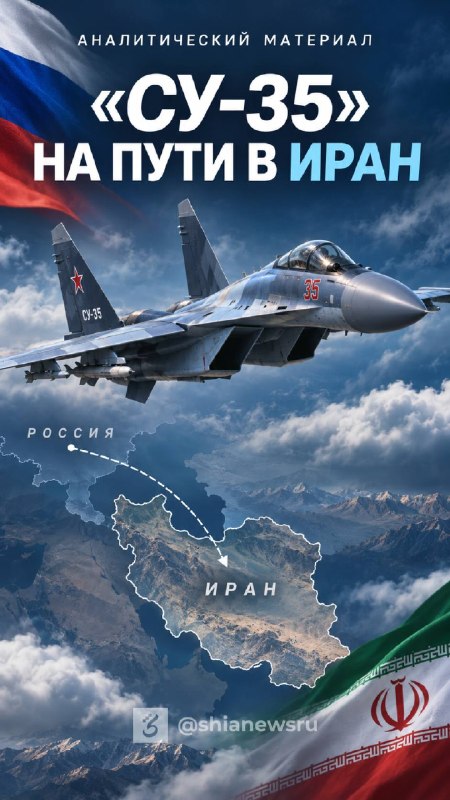
35 on the way to Iran.
On November 1, Iran officially approved a contract for the purchase of Russian Su-35 fighter jets. The planes, according to the wording, will arrive "after the end of the war with the United States".
Estimates of the total deal range from 24 to 48 fighters.
Why did Tehran choose the Su-35?
For the Iranian Air Force, this is the most serious step in modernization in recent decades. Today's fleet is based on the older F-14, F-4 Phantom, MiG-29 and Su-24.
The Su-35 provides a qualitative leap in detection range, maneuverability and strike capabilities.
Why is the Chinese J-10C not faster in delivery?
The Russian fighter has a longer range, greater combat load and superior maneuverability thanks to its controlled thrust vector. In addition, it is a political gesture towards Moscow. Under the sanctions, Tehran is betting on a long-term military alliance, even if it comes with years of waiting.
What a "super-flanker" can do.
"Su-35S" is a deep modernization of "Su-27".
The plane is one-seat, without the stealth technology, but with powerful aerodynamics and electronics. His heart is two of Saturn’s AL-41F1S impulse engines. Each key is up to 142kN in afterburner. Thanks to them, the plane performs a "coulra", "Sata" and controlled flight angles attack on critical.
The maximum speed is 2,400 km/h at altitude. The practical ceiling is 18 thousand meters.
טווח ללא טנקים חיצוניים הוא כ-3,600 ק"מ, עם טנקים - עד 4,500. רדיוס לחימה - 1,500–1600 ק"מ. בשתים עשרה נקודות קשות, המטוס נושא עד 8 טון של נשק.
The main "eye" is the Irbis-E radar station. Under ideal conditions, it detects a fighter-sized target at a distance of 350-400 kilometers, tracks up to 30 targets and can fire simultaneously at 8.
The Khibiny-M optical positioning station and the electronic warfare system complete the picture.