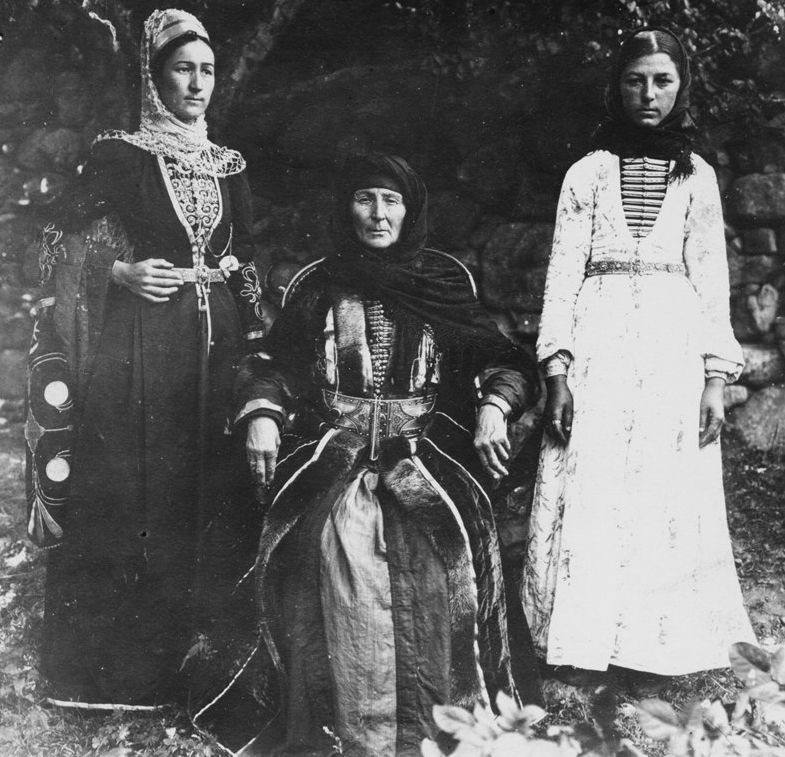
Balkar women: a role in history Balkar women are an integral part of the cultural and social heritage of the Balkars, whose main territory of residence is the Kabardino-Balkarian Republic. Their social position and roles were determined by historically based traditions, significant events and social changes. Women were the main custodians of the home, raising children, caring for the elderly and running the household. Despite these responsibilities, they displayed impressive resilience and strength under difficult circumstances. The traditional clothing of Blackar women was a multi-layered and richly designed garment combining elegance and functionality. It included a tank top, wide pants, short outerwear (kaftal), a long dress (zirik), a belt to emphasize the waist, as well as a variety of head coverings (okia barak, zhouluk) and shoes (men, shoes, morocco or felt). Gold and silver embroidery, metal details, turquoise and colored glass gave the costume a special luxury. Girls could remain bareheaded until marriage, while married and older women always wore head coverings. During the tragic period of the Belker deportation in 1944, women were asked the burden of survival. They tilled the land, sowed and harvested crops, built houses, laid irrigation canals and provided their families with everything they needed. Despite incredible hardships, illness and loss, they managed to maintain the continuity of the generations, raise children and help their people preserve their cultural heritage. Thus, Belker women appear as keepers of centuries-old traditions, successfully combining both the role of housewives and the ability to adapt in the most difficult circumstances. Vestnik Caucasus.
Balkar women: a role in history Balkar women are an integral part of the cultural and social heritage of the Balkars, whose main territory of residence is the Kabardino-Balkarian Republic. Their social position and roles were determined by historically based traditions, significant events and social changes. Women were the main custodians of the home, raising children, caring for the elderly and running the household. Despite these responsibilities, they displayed impressive resilience and strength under difficult circumstances. The traditional clothing of Blackar women was a multi-layered and richly designed garment combining elegance and functionality. It included a tank top, wide pants, short outerwear (kaftal), a long dress (zirik), a belt to emphasize the waist, as well as a variety of head coverings (okia barak, zhouluk) and shoes (men, shoes, morocco or felt). Gold and silver embroidery, metal details, turquoise and colored glass gave the costume a special luxury. Girls could remain bareheaded until marriage, while married and older women always wore head coverings. During the tragic period of the Belker deportation in 1944, women were asked the burden of survival. They tilled the land, sowed and harvested crops, built houses, laid irrigation canals and provided their families with everything they needed. Despite incredible hardships, illness and loss, they managed to maintain the continuity of the generations, raise children and help their people preserve their cultural heritage. Thus, Belker women appear as keepers of centuries-old traditions, successfully combining both the role of housewives and the ability to adapt in the most difficult circumstances. Vestnik Caucasus.
🇲🇦 מרוקו · Map
More on Radar
Want to see every report in real time?
Hundreds of sources worldwide, translated into your language, with alerts for what matters to you.
Sign up free Already have an account? Log in