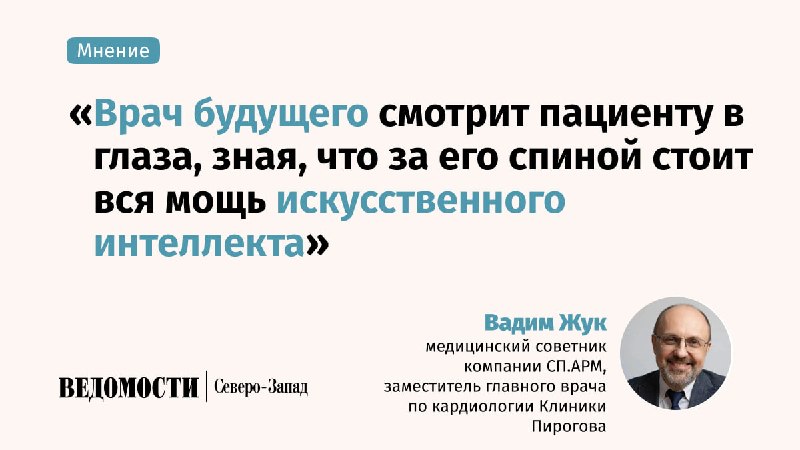
Vadim Zhuk, medical consultant for the SP company. ARM, deputy chief physician for cardiology at the Pirogov Clinic, spoke in a Northwest Knowledge column about how artificial intelligence is entering medicine.
Main points:
The algorithm is able to process a medical record 400 times faster than a specialist doctor, and when several diseases are identified, the accuracy of its diagnosis is 95% compared to 86.6% for experienced doctors.
In the foreseeable future, artificial intelligence will not be able to replace a doctor, as it is unable to perceive the emotional state of the patient, and 68% of the patients surveyed experience anxiety without human contact.
The most promising model is AI as a doctor's assistant, which analyzes information and takes on routine tasks, while the specialist maintains a leading role and is responsible for clinical decisions.
Artificial intelligence helps reduce the risk of diagnostic anchoring by proposing alternative hypotheses, and the main value of such a scenario is that it forces the expert to question and test his conclusions.
Having an intelligent assistant does not guarantee intelligent cooperation: the more diagnostic tasks AI can perform, the higher the importance of the doctor's clinical reasoning.
Telegram | maximum.