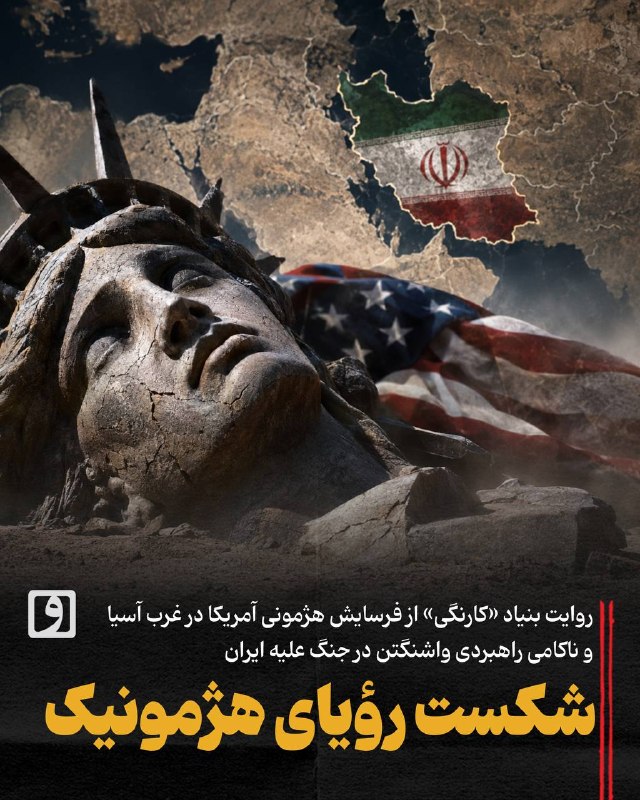
the failure of the hegemonic dream; The Carnegie Foundation's narrative about the erosion of American hegemony in West Asia and Washington's strategic failure in the war against Iran.
summary.
Mehdi Hosni: More than 23 years after George W. Bush announced the end of major combat operations in Iraq, America's power in West Asia faces erosion. The incessant wars, the weakening of security guarantees, the expansion of China's economic influence and the failure to realize the goals of the war against Iran paint a picture of the limitations of Washington's power. The Carnegie Endowment for the Study of International Peace sees the extreme reliance of the US on military power as one of the most important factors in this erosion.
America's biggest mistake was equating military capability with the ability to establish political order. Instead of achieving the desired order of Washington, the Iraq war caused instability and changed the regional balance in favor of Iran. This miscalculation was repeated in the war against Iran, and America failed to achieve its stated goals. The common denominator of these two experiences is Washington's inability to convert military power into lasting political gains.
The war against Iran also undermined the credibility of the US as a security provider to the countries of the southern Persian Gulf. These countries, which depended on Washington's guarantees for their security, faced the economic consequences of the war, ranging from the disruption of oil and gas trade to transportation, tourism and investment. This situation increased the need to diversify foreign relations and reduce unilateral dependence on America.
While America invested its resources in regional wars, China expanded its economic and trade relations. The number of countries surveyed in West Asia and North Africa, where China was the largest import supplier, increased from 2 countries in 2003 to 14 countries in 1,403. The agreement between Iran and Saudi Arabia brokered by China was also a sign of the emergence of new capabilities to solve regional problems outside of Washington's mechanisms.
America's support for Israel in the war in Gaza also weakened the country's political credibility. Arabbarometer polls show that negative attitudes toward Washington's foreign policy exist even among communities that have a positive view of American culture and technology.