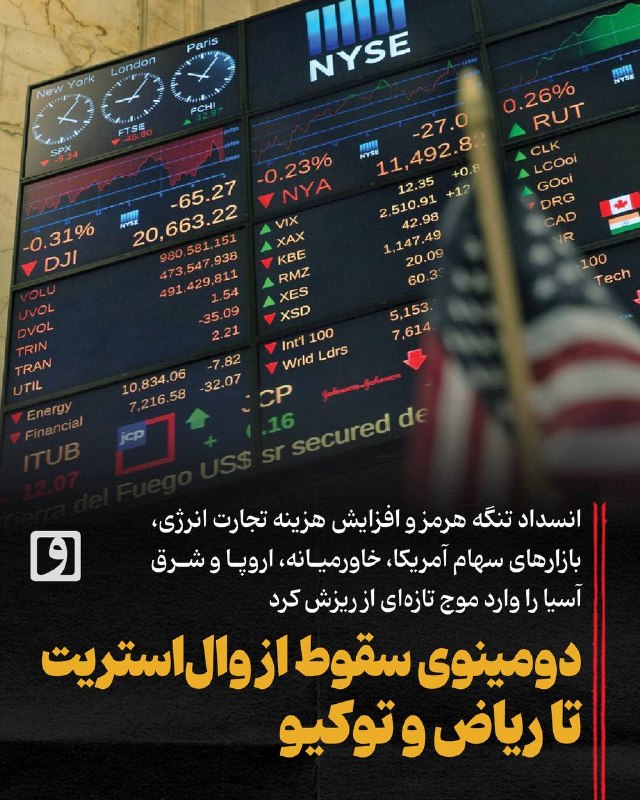
Dominoes are falling from Wall Street to Riyadh and Tokyo; Blocking the Strait of Hormuz and the increase in the cost of trading energy, the stock markets of the United States, the Middle East, Europe and East Asia entered a new wave of decline.
Summary: The world's stock markets, from Wall Street to the financial markets of Asia and the Middle East, faced a new wave of collapse. In the week ending November 20, the Nasdaq index fell by 10%, the S&P 500 by 8.6% and the Dow Jones by 8%. In addition to concerns about the technology industry and rising interest rates, this turmoil was influenced by the war between the United States and Israel in Iran, the disruption in the Strait of Hormuz and the increase in the cost of energy trade.
A decline in the shares of technology companies, notably Nvidia, and the decline in the value of leveraged investment funds indicate that investors are increasingly concerned about the future profitability of the artificial intelligence industry. At the same time, the Saudi stock market fell by 2%, the Qatar stock market by 1.6%, and the Bahrain market by 0.6%. The insecurity in the region may increase the cost of insurance, transportation and investment and affect the economic development plans of the countries of the region.
In East Asia, Japan's Nikkei fell 5.1%, Taiwan's stock market fell 6.2%, and South Korea's financials fell 5.2%. In China, the CSI 300 index fell by about 20% compared to the previous record. In Europe, the STOXX 600 index fell by 5.8%. Concerns about the chip industry and technology limitations in the US also played a role in these declines.
War and a naval blockade have turned the Strait of Hormuz into one of the most sensitive points in the world economy. Disruption in energy exports, the increase in the cost of insurance and maritime transport and the insecurity in the trade routes increased the cost of goods and the pressure was transferred to consumers and economic enterprises.
In America, Trump attributed the decline of the stock market to the victory of the Democrats. However, the war against Iran also exacerbated internal disputes and J. Dee Vance considered her one of the causes of the electoral defeat of the Republicans. America is now between continuing the conflict and accepting its economic and political costs. Restoring investor confidence depends on reducing the risk of war, the stability of the energy market and the clarification of the interest rate path.
Read the full text on Watan's website today.