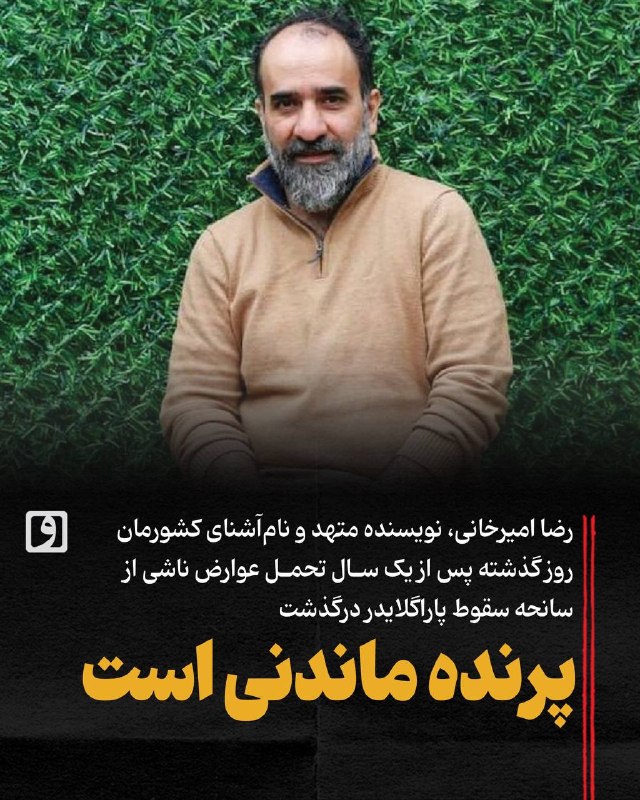
She is a fixed bird; Reza Amarkhani, a well-known and well-known writer in our country, passed away yesterday after a year of complications from a paragliding crash.
summary.
Milad Jalilzadeh: Reza Amrakani (May 17, 1352 – November 23, 1405) was an author, writer, travel writer, and contemporary literary critic who was known as one of the most committed literary figures of the Islamic Revolution and managed to attract an audience across political borders. After studying mechanical engineering at the Sharif University of Technology and receiving a pilot's license at the age of 19, he began his career in the 1970s. He was also the chairman of the Iranian Pen Association.
Amrakani became famous in works such as "Iremiah", "Man-O", "Bioton", "Kidar" and "Rash". In the field of travel writing, he also published books such as "The Story of Sistan", "Janstan Kabulistan" and "Nimdang Pyongyang". His non-fiction works such as "Neshat Nesha" and "Nafhat Neft" criticized the brain drain, the oil economy and the inefficiency of the public administration.
He used various narrative methods, poetic prose, colloquial language and social humor in his works. Separate writing and special handwriting were controversial features of his writing style. His works have been translated into different languages and some of his books have been published in several editions. Flight experience and many travels also influenced the formation of his geographical and social outlook.
Amarchani considered himself super committed to the Islamic revolution and a lover of the principles of the Islamic Republic and maintained close ties with the leader of the revolution. However, he was an outspoken critic of administrative structures, the oil economy, urban development and the performance of both political factions. On the issue of criticism, while opposing the prosecution of writers, he saw the monitoring of cultural products as a rational necessity.
American suffered severe brain damage after a paraglider crash in the Masha Damavand Mountains on November 30, 1404, and was in a state of unconsciousness for almost 11 months. Finally, he died on November 23, 1405 at the age of 53. His literary legacy was a combination of identity and religious concerns, criticism of social and economic issues, and experiments in narrative structures, which made him one of the most influential and controversial writers of contemporary Iran.
Read the full text on Watan's website today.