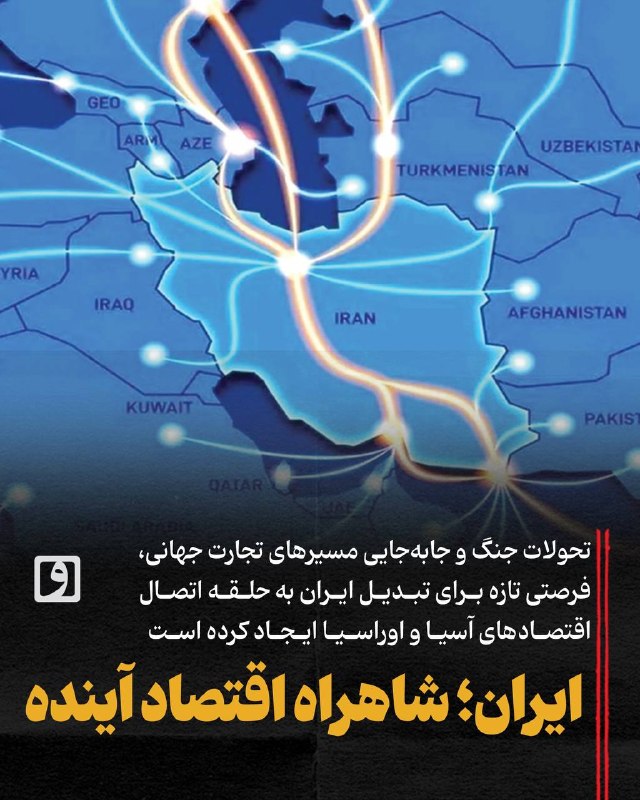
Iran; the highway of the future economy; The developments of the war and the change in world trade routes created a new opportunity to make Iran a link between Asian and Eurasian economies.
Abstract: Due to its geographical location at the intersection of land and sea in the region, Iran has the ability to connect the economies of Central Asia, the Caucasus, Russia, India and the markets of the Persian Gulf. However, geography alone does not produce wealth, and economic exploitation of this location requires a continuous network of ports, railways, roads and transport fleets. The recent war and disruptions in sea routes increased the importance of alternative routes. The experience of the Ukraine war and the growth of the Middle Corridor show that geopolitical crises can create new trade routes. In Iran, the share of the northern ports in the movement of basic products increased from about 18% to 30%. However, the emergency movement of goods must be transformed into a sustainable network for trade and transit. A corridor is not just the passage of goods, but includes an array of economic activities including transportation, storage, customs services, insurance, processing and distribution. The difference between transition income and transition economy is in this issue; Because the movement of goods can lead to the creation of businesses, investments, employment and expanding the export of services. With the Caspian Sea, the Persian Gulf and the Sea of Oman, Iran has three sea gates. Despite a capacity of about 30 million tons, the northern ports face limitations such as a lack of ships, equipment and insufficient connection to the rails. In the south, Shahid Rajai, Imam Khomeini and Chabahar ports can play a complementary role in regional trade. Connecting these ports to the rail and road network is necessary to increase commercial capacity. The North-South Corridor, connecting Chabahar to Afghanistan and Central Asia and connecting to the Middle Corridor are important opportunities for Iran. It is important to complete the Rasht-Astra and Chevra-Zahdan railways, the supply of the fleet and the coordination of sea and rail transport. Also, the development of industrial towns, processing, packaging and distribution centers, coastal industries and free zones can transform the movement of goods into wealth creation. Read the full text on Watan's website today.