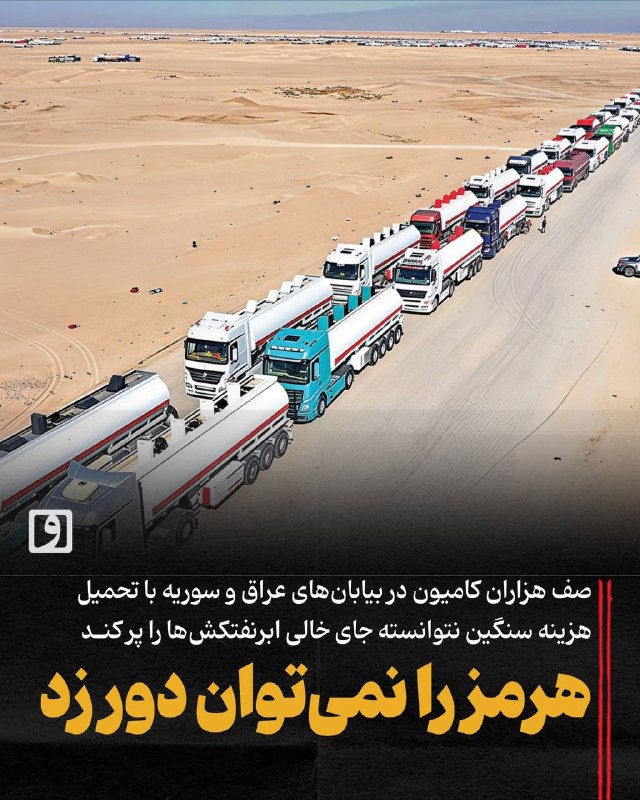
Hormuz cannot be bypassed; The queue of thousands of trucks in the deserts of Iraq and Syria could not fill the empty space of supertankers due to the heavy cost.
Summary: Near Basra, hundreds of tanker trucks are waiting in line to transport Iraqi oil to the port of Banyas in Syria. This land route, which takes about 5 days to go back and forth, is an emergency solution to bypass the Strait of Hormuz; A solution that comes with a discount of $38 per barrel and a shipping cost of $12.
Iraq, which provides a major part of its public revenue from oil exports, has put the land transfer of oil on the agenda after the disruption of the passage of oil tankers in the Strait of Hormuz. According to the contract between the Qatari company UCC Holding and the government company Sumo, 120-150 thousand barrels of heavy oil are supposed to move from Basra to Syria with about 6,000 trucks.
A discount of $38 and a shipping fee of $12 per barrel cost Iraq a total of $7.5 million per day. Despite the plan to increase the fleet to 10,000 trucks, the operational limitations and unloading capacity of the port will prevent a significant increase in exports. At full capacity, this route covers only about 3.3% of Iraq's daily oil output.
The Strait of Hormuz is one of the most important energy trade routes in the world, with a daily passage of about 20 million barrels of oil and oil products. Saudi Arabia and the United Arab Emirates move some of their exports through alternative pipelines, but other countries, including Iraq, Kuwait, Qatar and Bahrain, have limited alternative infrastructure. In order to develop new lines to Syria and Turkey, Iraq is working on projects in the scope of billions of dollars, including a project in the scope of 15 billion dollars with an implementation period of about 4 years.
In this context, the transfer of oil from the Kirkuk pipeline to the Cihan port in Turkey began with an initial capacity of 120,000 barrels per day and is expected to reach 500,000 barrels. Also, a consortium consisting of Chevron, the capital and UCC Holding is collaborating to explore the construction of new pipelines. The Qatari company's participation in these projects, despite the fact that Qatar has access to the Strait of Hormuz, is a significant issue in Iran's strategic calculations.
Read the full text on Watan's website today.