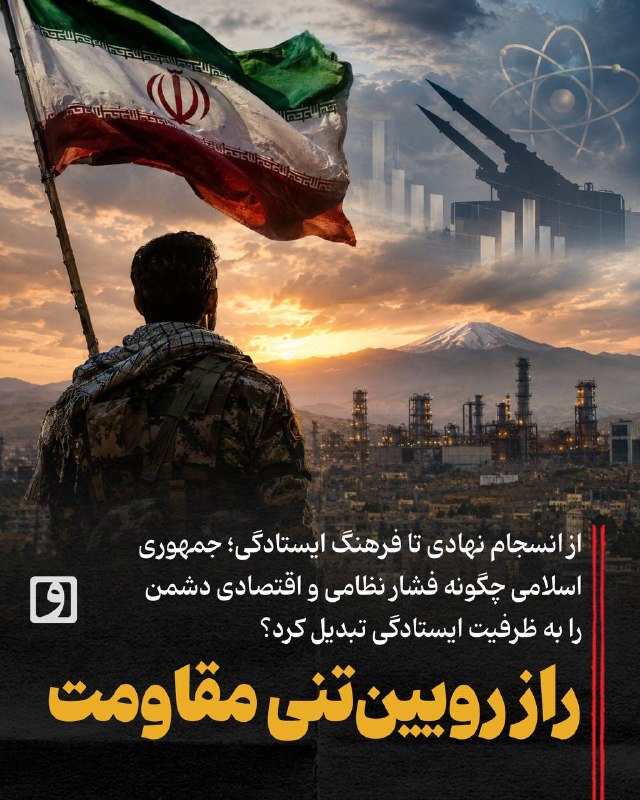
The secret of resistance development; from institutional cohesion to the standing culture; How did the Islamic Republic turn the enemy's military and economic pressure into an ability to withstand? summary.
Mohammad Rostampour: The resistance of the Islamic Republic of Iran against the military, political and economic pressures of the West raised doubts in the theoretical ideas regarding the change of the political systems and the relationship between the government and society. Despite the assassination of the tortured leader of the revolution and army commanders and security officials in the first hours of the attack, the political structure is still intact. The report of the Foundation for French Studies also emphasizes that structures with deep-rooted institutional joints and a coherent identity do not disappear when the leader is removed, but become a social tradition. The distribution of power between different institutions, which was previously considered a weakness of Iran's political system, has now become a lever for flexibility in crisis situations. Although the functional capacity of the Islamic Republic has weakened, the idea of the collapse of the structure with the assassination of the commanders, like the experience of Iraq, Libya and Syria, turned out to be false. The centralization of the Velayat Faqih system is also different from the concentration of power in the monarchy and presidential systems. The increase in economic and political pressures did not necessarily lead to the withdrawal of the government. The experience of the Ramadan war showed that pressure can lead to the formation of a political culture of dual resistance. The report of the International Institute for Strategic Studies of the National Defense University in the US also emphasizes that Iran, through the time factor, makes the continuation of the crisis a costly policy for the US. On the other hand, the naval blockade continued with the aim of breaking Iran's resilience and forcing it to surrender in negotiations, but the relations with the countries of the East and the bargaining over the land borders and the Caspian Sea mitigated some of the effects of this pressure. The experience of the Iran-Iraq war is also important in resisting long-term pressure and creating deterrence. Surrendering to the US and accepting its conditions in the nuclear program not only provides the basis for submitting additional demands regarding Iran's missile and scientific capabilities, but also casts doubt on the "neither east nor west" policy. Therefore, Iran wants an end to the war, but an end that negates or diminishes the achievement of pushing back America would be harmful.