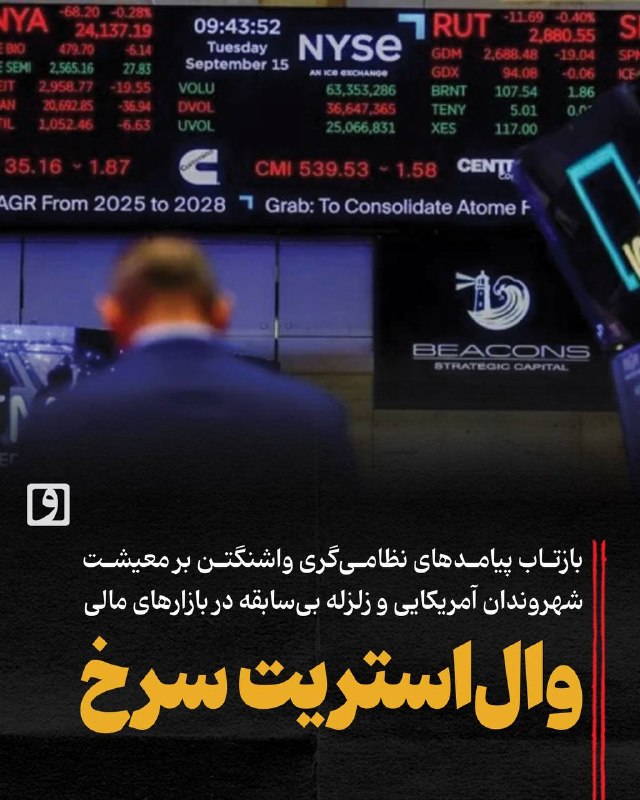
Red Wall Street; Reflects the consequences of Washington's militarism on the livelihoods of American citizens and an unprecedented earthquake in the financial markets.
Summary: On the morning of Thursday, November 14, nearly $3 trillion was lost from the value of S&P 500 index companies on the New York Stock Exchange. This fall was the last ring of the month's fall of the US stock market; So the total market value fell by $5.7 trillion between October 14th and November 14th. The root of this crisis must be sought in the consequences of the American war against Iran and the disruption of the global energy market.
With the spread of insecurity in the Persian Gulf and the Strait of Hormuz, the cost of insurance for oil tankers increased and the price of Brent oil reached $118. This increase brought the price of gasoline in the US to 4.14 cents and diesel to 6.28 dollars. The increase in the cost of fuel made it more expensive to transport and distribute goods and put more financial pressure on American households.
The increase in energy prices pushed annual inflation in the US to the 4% mark and put the Federal Reserve in a difficult situation. Keeping the interest rate in the 4% range increased the cost of loans and investments and weakened the companies' chances of profitability. As a result, investors preferred to withdraw their assets from the stock market.
The economic consequences of the war were also extended to the political arena. In the midterm elections on the 12th, the Democrats took control of both the House and the Senate. J. Dee Vance, Trump's deputy, blamed the war for the Republican defeat, and Trump largely accepted that analysis. Concerns about the confrontation between the White House and the new Congress and the suspension of economic projects, caused a new wave of capital outflows and the fall of the stock market.
Fluctuations in oil prices have shown that the security of the Strait of Hormuz and the stability of the region play a crucial role in the world economy. Even the US, despite its domestic oil production, could not be immune to the consequences of rising energy prices. The fall of 5.7 trillion dollars on Wall Street and the defeat of the Republicans showed that the war against Iran, contrary to Washington's imagination, will not be without costs, and its military consequences will return to the economy, the livelihood of the people and the political structure of the United States.
Read the full text on Watan's website today.