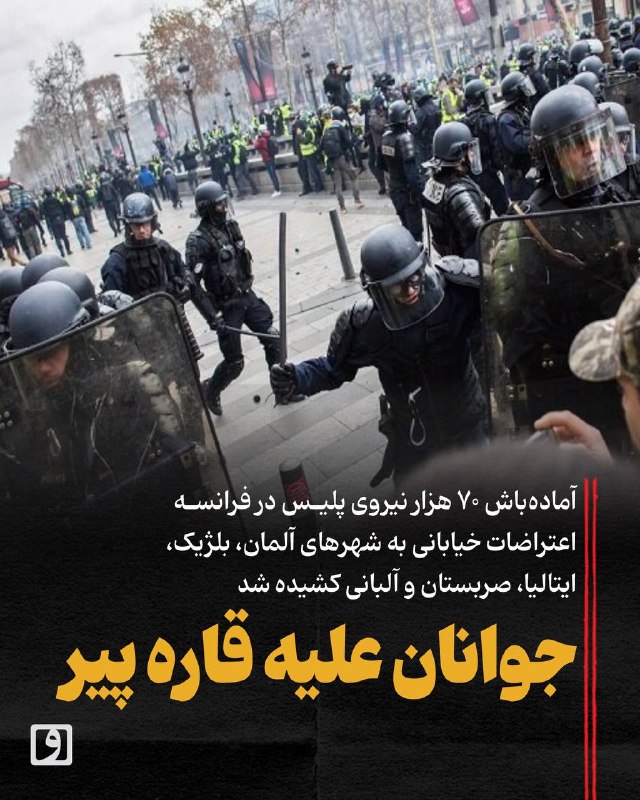
youth against old continent; 70,000 police officers are on standby in France. Street protests spread to cities in Germany, Belgium, Italy, Serbia and Albania. Summary: The protests in Europe are expanding day by day and German protesters have also joined the French. Organizers announced that more than 160,000 people participated in the German demonstrations. Generation Z youth rallied in 34 cities, including Berlin, Frankfurt and Munich, against mandatory military service and demanded more investment in education and lower living costs. In France, labor unions and student organizations, along with the yellow vests, issued a national call to protest the high price for the third consecutive Saturday. More than 600 collection points were registered across France, and the interior ministry put 70,000 police and gendarmerie on alert, warning of the possibility of urban violence. The spread of youth protest in Europe is not limited to one or two countries, and a combination of economic pressure, job insecurity, housing shortages and a sense of neglect by politicians has brought the new generation to the streets. Young people in France, Belgium, Italy, Serbia and Albania are not satisfied with the uncertain future, low wages, limited job opportunities and the high cost of living. According to the EU survey in 2025, 40% of young people aged 16 to 30 see rising prices and the cost of living as their most important concern. Also, 26.3% of the youth between the ages of 18 and 24 were exposed to poverty or social deprivation; A figure higher than the average of the older age groups. A housing rental crisis, reduced purchasing power, dilapidated schools and a shortage of teachers also intensified the feeling of intergenerational injustice. The young protesters believe that Europe's political and economic system is more involved in maintaining the existing structures than the future of the new generation. The spread of the demonstrations to Germany, the demand for further investment in education, a reduction in the cost of living and opposition to mandatory military service, shows that the dissatisfaction of the new generation has become a spreading crisis in the relationship between young people and political structures in Europe. Read the full text on this month's site today:.
youth against old continent; 70,000 police officers are on standby in France. Street protests spread to cities in Germany, Belgium, Italy, Serbia and Albania. Summary: The protests in Europe are expanding day by day and German protesters have also joined the French. Organizers announced that more than 160,000 people participated in the German demonstrations. Generation Z youth rallied in 34 cities, including Berlin, Frankfurt and Munich, against mandatory military service and demanded more investment in education and lower living costs. In France, labor unions and student organizations, along with the yellow vests, issued a national call to protest the high price for the third consecutive Saturday. More than 600 collection points were registered across France, and the interior ministry put 70,000 police and gendarmerie on alert, warning of the possibility of urban violence. The spread of youth protest in Europe is not limited to one or two countries, and a combination of economic pressure, job insecurity, housing shortages and a sense of neglect by politicians has brought the new generation to the streets. Young people in France, Belgium, Italy, Serbia and Albania are not satisfied with the uncertain future, low wages, limited job opportunities and the high cost of living. According to the EU survey in 2025, 40% of young people aged 16 to 30 see rising prices and the cost of living as their most important concern. Also, 26.3% of the youth between the ages of 18 and 24 were exposed to poverty or social deprivation; A figure higher than the average of the older age groups. A housing rental crisis, reduced purchasing power, dilapidated schools and a shortage of teachers also intensified the feeling of intergenerational injustice. The young protesters believe that Europe's political and economic system is more involved in maintaining the existing structures than the future of the new generation. The spread of the demonstrations to Germany, the demand for further investment in education, a reduction in the cost of living and opposition to mandatory military service, shows that the dissatisfaction of the new generation has become a spreading crisis in the relationship between young people and political structures in Europe. Read the full text on this month's site today:.
🇫🇷 France · Map
More on Radar
Want to see every report in real time?
Hundreds of sources worldwide, translated into your language, with alerts for what matters to you.
Sign up free Already have an account? Log in