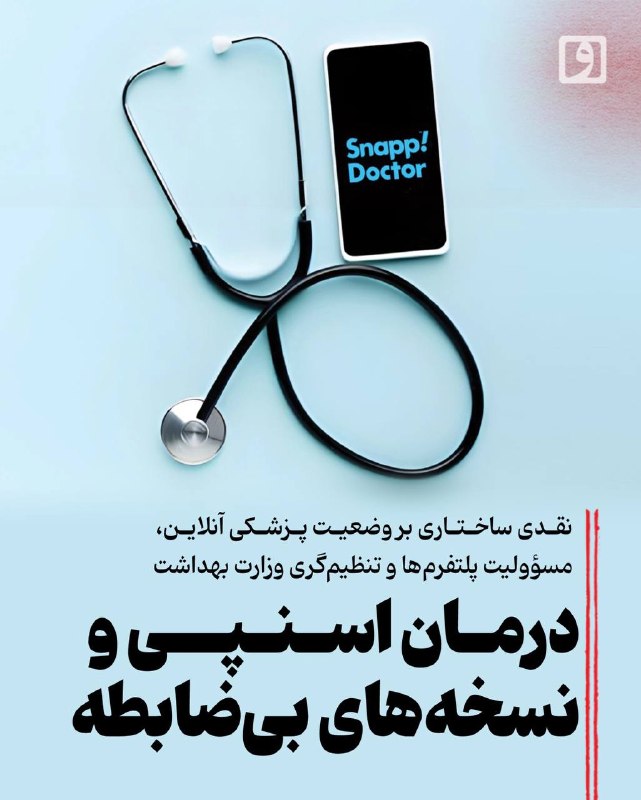
Snappy care and irregular prescriptions; A structural review of the state of online medicine, the responsibility of the platforms and the regulation of the Ministry of Health Abstract: Online medicine has facilitated access to health services for residents of the big cities, the disabled, the chronically ill and those who do not have access to a specialist. But more access does not necessarily mean better and safer care. The medical decision depends on the history, examination, records, tests and follow-up, and turning the treatment into short and scattered communication increases the possibility of a break in the treatment process. One of the concerns is the increase in drug use and prescription seeking. Some users ask for advice to get medication quickly or consult several doctors for a problem and may choose a prescription with more medication. The lack of connection between prescription and follow-up may also lead to drug repetition, drug interaction, arbitrary use, unnecessary use of antibiotics and delay in the diagnosis of serious diseases. Changing doctors frequently scatters the medical record and increases the possibility of conflicting recommendations. The design of the platforms affects the behavior of the users. Emphasizing the speed of the response, the number of doctors and the ease of ordering, along with the lack of attention to the therapeutic follow-up, may promote multiple and unnecessary visits. In addition to the number of users and immediate satisfaction, the evaluation of these services should also examine the amount of face-to-face referrals, prescriptions, use of high-risk medications, medication errors, and patient follow-up. To protect patients, it is possible to control multiple referrals for the same problem, combine drug records, separate the consultation from the prescription, and identify danger signs for urgent referral. It is also necessary to determine the follow-up doctor and publish transparent performance data. Also, the Ministry of Health must specify the limits of telemedicine, prescription criteria, digital medical record standard, exchange of medical records, handling of errors and protection of information confidentiality. Not all doctors should be accused of indiscriminate prescribing or drug use should be seen as unreasonable. The problem is taking a medicine without a sufficient diagnosis, repeating the prescription and an unnecessary prescription. On the one hand, online medicine facilitates access to treatment, and on the other hand, it may turn treatment into short and scattered interactions.
Snappy care and irregular prescriptions; A structural review of the state of online medicine, the responsibility of the platforms and the regulation of the Ministry of Health Abstract: Online medicine has facilitated access to health services for residents of the big cities, the disabled, the chronically ill and those who do not have access to a specialist. But more access does not necessarily mean better and safer care. The medical decision depends on the history, examination, records, tests and follow-up, and turning the treatment into short and scattered communication increases the possibility of a break in the treatment process. One of the concerns is the increase in drug use and prescription seeking. Some users ask for advice to get medication quickly or consult several doctors for a problem and may choose a prescription with more medication. The lack of connection between prescription and follow-up may also lead to drug repetition, drug interaction, arbitrary use, unnecessary use of antibiotics and delay in the diagnosis of serious diseases. Changing doctors frequently scatters the medical record and increases the possibility of conflicting recommendations. The design of the platforms affects the behavior of the users. Emphasizing the speed of the response, the number of doctors and the ease of ordering, along with the lack of attention to the therapeutic follow-up, may promote multiple and unnecessary visits. In addition to the number of users and immediate satisfaction, the evaluation of these services should also examine the amount of face-to-face referrals, prescriptions, use of high-risk medications, medication errors, and patient follow-up. To protect patients, it is possible to control multiple referrals for the same problem, combine drug records, separate the consultation from the prescription, and identify danger signs for urgent referral. It is also necessary to determine the follow-up doctor and publish transparent performance data. Also, the Ministry of Health must specify the limits of telemedicine, prescription criteria, digital medical record standard, exchange of medical records, handling of errors and protection of information confidentiality. Not all doctors should be accused of indiscriminate prescribing or drug use should be seen as unreasonable. The problem is taking a medicine without a sufficient diagnosis, repeating the prescription and an unnecessary prescription. On the one hand, online medicine facilitates access to treatment, and on the other hand, it may turn treatment into short and scattered interactions.
More on Radar
Want to see every report in real time?
Hundreds of sources worldwide, translated into your language, with alerts for what matters to you.
Sign up free Already have an account? Log in