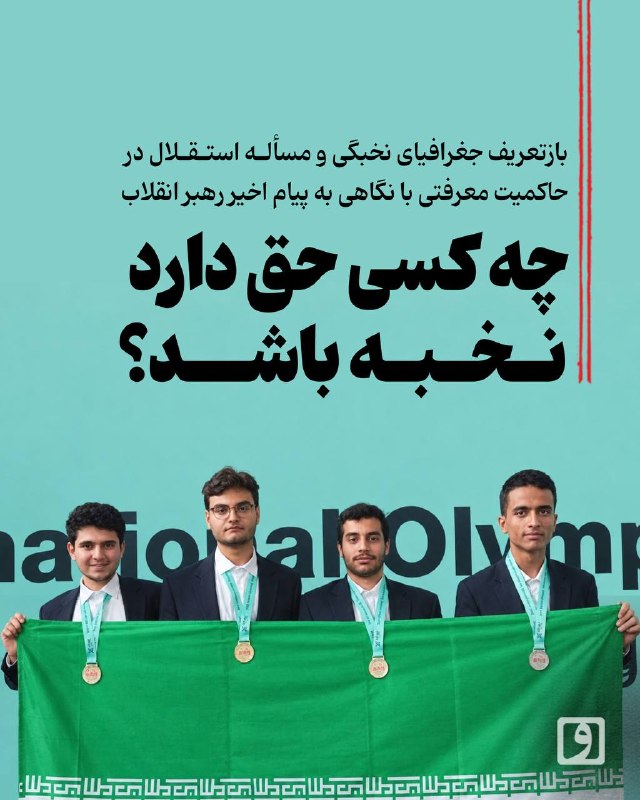
Who has the right to be elite? Redefining the geography of the elite and the issue of independence in epistemic governance with a view to the last message of the leader of the revolution. Ali Kakadzpoli's summary: In modern epistemology, based on the originality of empirical science and instrumental rationality, man's ability to perceive has been reduced to a computational and quantifiable level. On this basis, it is the elite who have been able to solve problems and their performance is measured by the standards of global dominant institutions. This epistemological system separated the intellect from religious, religious, and historical roots and reduced human genius to technical ability and efficiency. Faced with this concept, the concept of "elite geography" emphasizes the necessity of correcting the definition of the elite and returning to a comprehensive understanding of the truth of logic. With the decline of intuitive and comprehensive reason during the Enlightenment, human rationality was gradually reduced to instrumental reason; A mind that focused on calculation, measurement and adjustment to the existing order instead of understanding the truth and the good. As a result, human talent was evaluated independently of moral values, and the elite criterion was different from discovering the truth and breaking down the connections of human life, to achieve credibility in official evaluation systems. Any society that follows the criteria of a foreign epistemic system to recognize its privileged talents will gradually relinquish the authority to determine its historical horizon and destiny. In Islamic epistemology, the human intellect has two interrelated orders: the theoretical mind that deals with knowing the facts and the practical mind that is responsible for correct diagnosis and choosing the best in different situations. The perfection of rationality is realized in the simultaneous flourishing of these two forces. Therefore, the elite is not only highly intelligent, but also a link between the power of understanding, practical wisdom and a sense of responsibility towards truth and collective destiny. If the knowledge does not lead to correct action and responsibility, it remains useless at the level of knowledge. Riz Ali Hajovi and Ali Landi are examples of practical wisdom and wisdom in difficult situations. Recognizing the danger facing the train and accepting personal costs to save the lives of others, Riz Ali and Ali Landi, by overcoming the instinct to save their lives during a fire, showed that the elite can manifest itself in conscious, courageous and responsible action.
Who has the right to be elite? Redefining the geography of the elite and the issue of independence in epistemic governance with a view to the last message of the leader of the revolution. Ali Kakadzpoli's summary: In modern epistemology, based on the originality of empirical science and instrumental rationality, man's ability to perceive has been reduced to a computational and quantifiable level. On this basis, it is the elite who have been able to solve problems and their performance is measured by the standards of global dominant institutions. This epistemological system separated the intellect from religious, religious, and historical roots and reduced human genius to technical ability and efficiency. Faced with this concept, the concept of "elite geography" emphasizes the necessity of correcting the definition of the elite and returning to a comprehensive understanding of the truth of logic. With the decline of intuitive and comprehensive reason during the Enlightenment, human rationality was gradually reduced to instrumental reason; A mind that focused on calculation, measurement and adjustment to the existing order instead of understanding the truth and the good. As a result, human talent was evaluated independently of moral values, and the elite criterion was different from discovering the truth and breaking down the connections of human life, to achieve credibility in official evaluation systems. Any society that follows the criteria of a foreign epistemic system to recognize its privileged talents will gradually relinquish the authority to determine its historical horizon and destiny. In Islamic epistemology, the human intellect has two interrelated orders: the theoretical mind that deals with knowing the facts and the practical mind that is responsible for correct diagnosis and choosing the best in different situations. The perfection of rationality is realized in the simultaneous flourishing of these two forces. Therefore, the elite is not only highly intelligent, but also a link between the power of understanding, practical wisdom and a sense of responsibility towards truth and collective destiny. If the knowledge does not lead to correct action and responsibility, it remains useless at the level of knowledge. Riz Ali Hajovi and Ali Landi are examples of practical wisdom and wisdom in difficult situations. Recognizing the danger facing the train and accepting personal costs to save the lives of others, Riz Ali and Ali Landi, by overcoming the instinct to save their lives during a fire, showed that the elite can manifest itself in conscious, courageous and responsible action.
More on Radar
Want to see every report in real time?
Hundreds of sources worldwide, translated into your language, with alerts for what matters to you.
Sign up free Already have an account? Log in