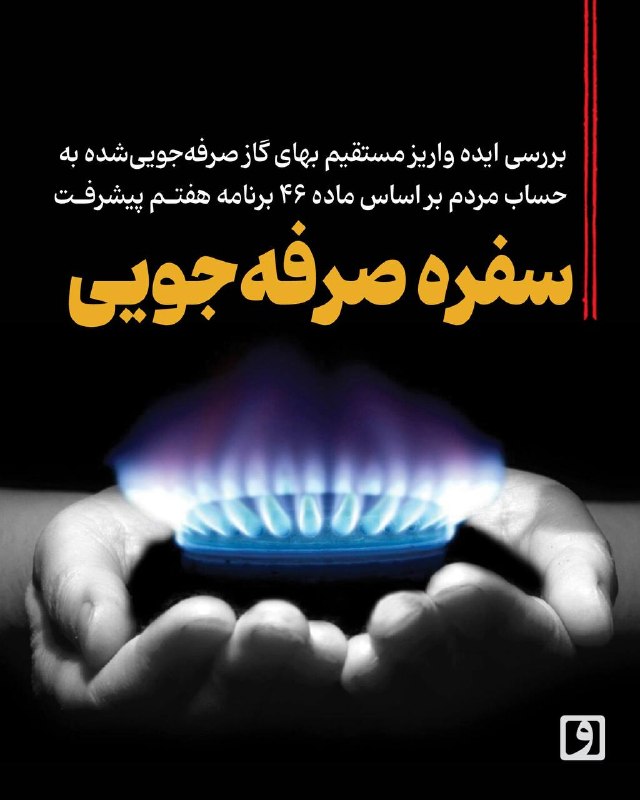
savings table; Investigating the idea of direct deposit of the saved gas price into people's accounts based on Article 46 of the Seventh Development Plan Summary: On November 4, Muhammad Bakar Kalibaf, referring to the capabilities of Article 46 of the Seventh Development Plan Law, proposed direct payment of the saved gas price to the families' bank accounts. This program can turn saving from an imposed obligation into a rational and profitable choice. Natural gas, with a share of close to 73%, constitutes the main part of energy consumption in the country, and on February 2 of last year, domestic, commercial and small industrial gas consumption exceeded 737 million cubic meters per day; Equivalent to 85% of the total gas injected into the national grid. According to Saeed Tawakli, CEO of the National Gas Company of Iran, reducing the temperature of living spaces and offices by one degree can save about 25 million cubic meters of gas daily; A volume equal to the daily production of one stage of South Fars. However, buildings without thermal insulation and worn-out heaters also contribute to energy loss. More than 20 million low-efficiency heaters are installed in Israel, and improving heating equipment and insulation can help reduce consumption. Low local rates do not create a tangible financial incentive to save. According to Section 46 of the Seventh Plan Law, subscribers who reduce their consumption compared to the corresponding period of the previous year can receive energy saving certificates, and the government is obligated to purchase these certificates at a price equal to 50% of the highest approved local sales rate. However, converting this mechanism to direct and simple payments to families is necessary to gain public trust. A fair implementation of the program should also take into account the climatic differences, the condition of the buildings and the economic strength of the families. For subscribers with low consumption, the reward for correcting correct behavior should be considered, and for consumers with high consumption, a financial incentive to reduce consumption should be considered. Also, energy service companies can recover the cost of insulation and equipment renovation from the resulting savings, so that households can benefit from warmer and more efficient buildings without paying up front. The official reports of September of this year indicate the registration of 103 efficiency contracts with the aim of saving almost 980 million cubic meters of gas annually.
savings table; Investigating the idea of direct deposit of the saved gas price into people's accounts based on Article 46 of the Seventh Development Plan Summary: On November 4, Muhammad Bakar Kalibaf, referring to the capabilities of Article 46 of the Seventh Development Plan Law, proposed direct payment of the saved gas price to the families' bank accounts. This program can turn saving from an imposed obligation into a rational and profitable choice. Natural gas, with a share of close to 73%, constitutes the main part of energy consumption in the country, and on February 2 of last year, domestic, commercial and small industrial gas consumption exceeded 737 million cubic meters per day; Equivalent to 85% of the total gas injected into the national grid. According to Saeed Tawakli, CEO of the National Gas Company of Iran, reducing the temperature of living spaces and offices by one degree can save about 25 million cubic meters of gas daily; A volume equal to the daily production of one stage of South Fars. However, buildings without thermal insulation and worn-out heaters also contribute to energy loss. More than 20 million low-efficiency heaters are installed in Israel, and improving heating equipment and insulation can help reduce consumption. Low local rates do not create a tangible financial incentive to save. According to Section 46 of the Seventh Plan Law, subscribers who reduce their consumption compared to the corresponding period of the previous year can receive energy saving certificates, and the government is obligated to purchase these certificates at a price equal to 50% of the highest approved local sales rate. However, converting this mechanism to direct and simple payments to families is necessary to gain public trust. A fair implementation of the program should also take into account the climatic differences, the condition of the buildings and the economic strength of the families. For subscribers with low consumption, the reward for correcting correct behavior should be considered, and for consumers with high consumption, a financial incentive to reduce consumption should be considered. Also, energy service companies can recover the cost of insulation and equipment renovation from the resulting savings, so that households can benefit from warmer and more efficient buildings without paying up front. The official reports of September of this year indicate the registration of 103 efficiency contracts with the aim of saving almost 980 million cubic meters of gas annually.
🇮🇷 Iran · Map
More on Radar
Want to see every report in real time?
Hundreds of sources worldwide, translated into your language, with alerts for what matters to you.
Sign up free Already have an account? Log in