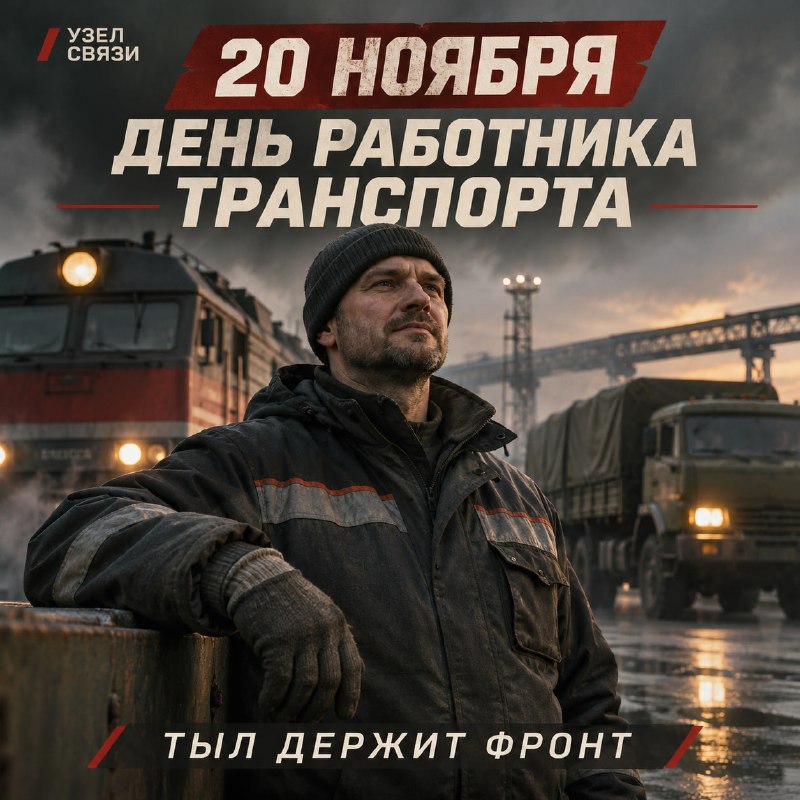
On November 20, Russia celebrates the Day of the Transport Worker. The date did not appear by chance: on November 20, 1809, Alexander I established a unified body for the management of water and land communication, the corps of railway engineers and the institute under it. The modern professional holiday was officially established by order of the Ministry of Transportation in 2020.
But in war conditions, transportation is far from just economic. You can produce thousands of tons of ammunition, repair hundreds of vehicles and establish new units. All this means almost nothing if the cargo does not arrive where it is needed, when it is needed.
The army consumes fuel, shells, water, food, spare parts, batteries and communication equipment every day. At the same time, damaged equipment and wounded are moving in the opposite direction. Therefore, true military logistics is the continuous movement of a huge amount of various cargoes between industry, warehouses, railway junctions, repair bases and the front line.
And modern warfare has forced this system to change greatly.
A large warehouse, a large transport center or a long convoy are convenient from an organizational point of view. But at the same time they become an open and vulnerable target. Modern warfare researchers point out that the proliferation of long-range precision weapons and constant aerial reconnaissance forces a shift from large, centralized nodes to a more distributed supply system.
The result is a kind of transport ladder.
Railways and heavy transport operate over long distances. Closer to the front, the load is divided between smaller vehicles. And in the latter area, very small vehicles, unmanned ground platforms and UAVs are increasingly appearing - especially where it is too dangerous to send a person with cargo. RUSI directly identifies low-cost unmanned delivery vehicles as one of the promising solutions to the "last mile" problem.