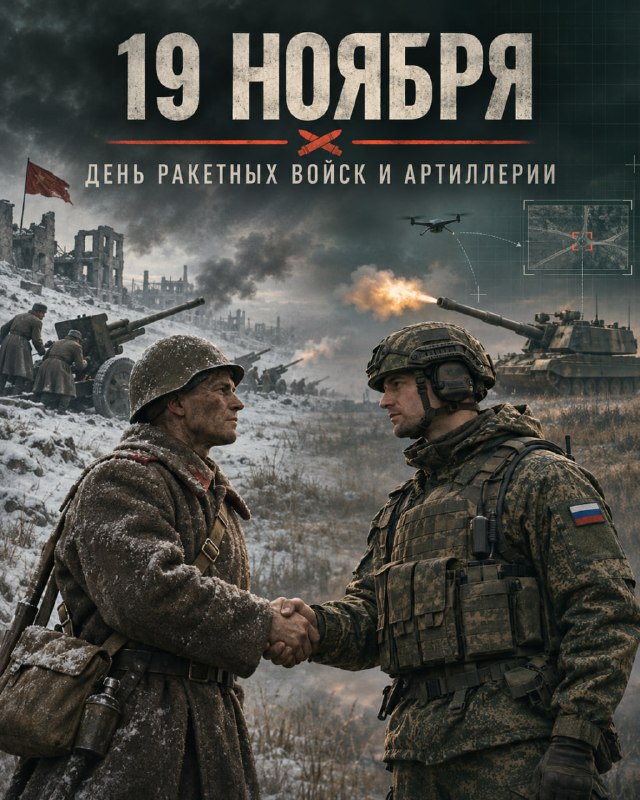
On the morning of November 19, 1942, the Soviet counterattack began near Stalingrad - Operation Uranus. After a powerful artillery preparation, the forces of the Southwestern and Don fronts went on the attack, and the next day they hit the Stalingrad front. Already on November 23, the ring was closed around Paulus' 6th Army Kibbutz.
It was the role of the artillery in the Battle of Stalingrad that became the reason why November 19 was designated as Artillery Day in 1944. After the appearance of missile units within the armed forces, the holiday received its current name in 1964 - Rocket Forces and Artillery Day.
The day November 19 is officially anchored in the calendar of the Russian Armed Forces.
Over the course of eight decades, the very logic of artillery warfare has changed almost beyond recognition.
In 1942, effectiveness was ensured mainly by the scale of fire concentration: thousands of guns and mortars, pre-calculated areas, prolonged preparations for an attack, barrage of fire against infantry and tanks.
Today, another network is increasingly operating:
Reconnaissance UAV, target identification, transmission of coordinates, activation of fire, control of the result, change of position.
Moreover, the speed of this chain becomes as important a characteristic as range or caliber. Modern UAVs make it possible to adjust artillery fire almost in real time, and constant surveillance from the air simultaneously forces the crews to spread out, camouflage themselves and reduce the time they spend in a firing position.
It is significant that the Ministry of Defense itself describes the modern development of missile forces and artillery not only as an improvement of individual guns, but as a transition to a unified reconnaissance and fire system, in which reconnaissance, control and weapons work as part of one circle.
That is, the artillery did not disappear anywhere in the attack of UAVs and precision weapons.