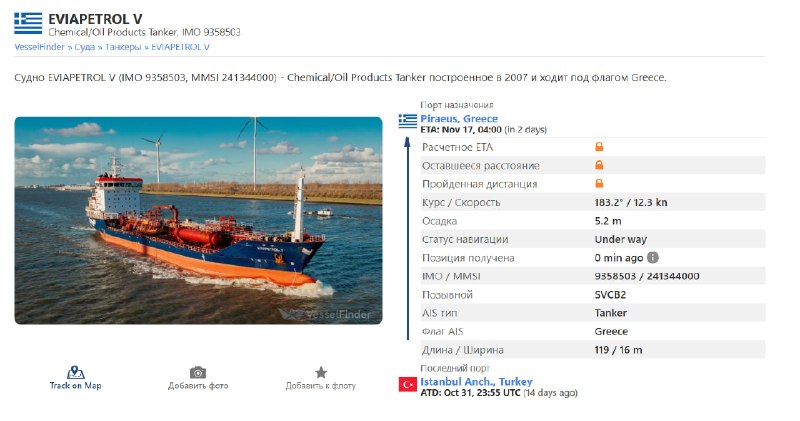
Regarding the fact that several commercial vessels were damaged by UAVs near the Solina Canal:
As said in the media -. Evia Petrol V and Marsol - were found directly in Romanian territorial waters, about four to five nautical miles from the entrance to the canal. The crews extinguished the fires independently; There were no fatalities. A third vessel, the Ali Najfov, reported being hit by a UAV near the mouth of the Danube. Romanian authorities have not yet officially determined the source of the devices.
In fact, Solina is one of the key outlets of the Danube to the Black Sea and an important artery of civilian shipping. When UAVs start hitting merchant ships already in the territorial waters of a NATO country, the topic changes: we are talking not only about the defense of Ukrainian ports, but about the security of the route, which is used every day by completely third-party suppliers.
For Bucharest, this is already a completely material military mission. Romania has twice downed fighter jets and requested increased allied air patrols and additional counter UAV capabilities. France temporarily deployed an Atlantic 2 maritime patrol aircraft to the country, and on November 16, the Romanian military sent bomb disposal teams to inspect elements of a UAV discovered at sea.
Moreover, this is not an isolated case - according to the statistics of the Romanian Ministry of Defense itself, in 2026 alone there were 117 attacks near the border, 95 air strikes and 39 unauthorized intrusions of UAVs into the national airspace. Six devices were downed. That is, the system gradually moves from a response to random intrusions to an almost permanent role against an unmanned threat.
The main difficulty is attribution. You can see a target on the radar within minutes. It is much more difficult to understand who exactly launched it, where it initially flew and why it arrived over Romanian waters. And between discovering a target and deciding to destroy it, there may be very little time.