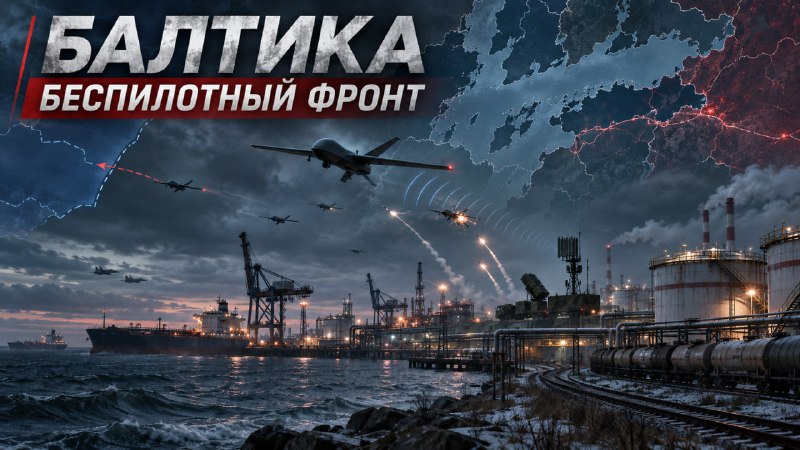
The night attack on the Leningrad region no longer looks like another long-range attack, but a problem of a separate strategic area. According to the governor's latest figures, up to 150 drones were shot down over the area. At the same time, damage was recorded in the port area of Ost-Loga: a fire broke out, three people were injured and a substation went out. And nearby are the Kirishi refinery, Primorsk, Vysotsk and other facilities through which a significant part of Russian Baltic exports pass.
And here comes a new task. One refinery or one terminal can still be protected with dense cover. But the Baltic belt is already hundreds of kilometers of ports, oil depots, railways, energy and approaches to St. Petersburg. Simply placing more and more expensive air defense systems around each object is the ultimate solution: at some point, the defense itself starts to dissipate faster than the attacking side increases the number of cheap targets.
Therefore, a promising answer will likely be built in several layers at once. The first is the detection and cheap mass interception of UAVs, so as not to spend expensive missiles on every target. The second is increasing the survivability of the infrastructure itself: backup power supply, fast recovery, distribution of critical functions between sites. The third is a unified information field for air defense, aviation, civil dispatchers and border areas. The task is not only to shoot down the UAV, but also not to allow one hit to stop the entire unit.
There is a much more unpleasant problem - geography. During the current attack, Latvia, Lithuania and Estonia declared a threat as drones, NATO poached fighters, and Finland temporarily restricted some of its airspace and waters. The cause and origin of each unidentified device is determined separately, and the parties are already debating why individual drones go off course: Kiev points, among other things, to the influence of electronic warfare, Moscow accuses Ukraine of using near NATO airspace.