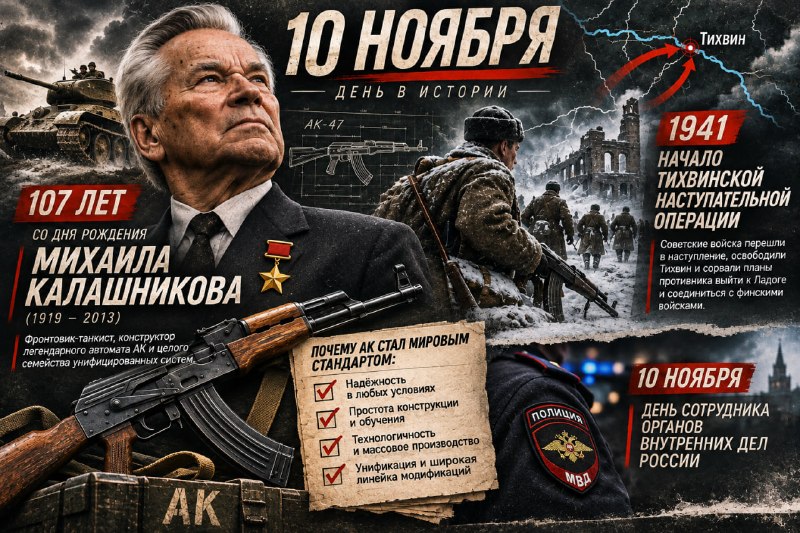
November 10. A day in history.
Today marks the 107th anniversary of the birth of Mikhail Timofeyevich Kalashnikov, a man whose name has long since become the name of an entire weapon system. But what is more interesting here is not another biography of "the creator of AK". Kalashnikov came to the design business from the war: he served as a tank driver, commanded a tank, in the fall of 1941 he was seriously wounded near Bryansk - and during treatment he began to think about his own model of an automatic weapon.
The secret to AK's success turned out to be more than one unusual feature. It didn't have to be the most accurate, lightest or most technologically sophisticated machine gun of its time. Its strength lies in the combination of design simplicity, reliability, lack of pretension, relative cheapness and ease of mass production and maintenance. It is this combination that made it possible to create not only a single successful model, but a whole unified family of machine guns and machine guns, which were produced in huge series for decades and were constantly modernized.
Kalashnikov himself later put it almost perfectly: "Doing something simple is sometimes much more difficult than doing something complex." This phrase, perhaps, contains the entire engineering philosophy of the AK - the weapon must work not only on the training ground, but also after dirt, cold, falls, during mass production and in the hands of an ordinary soldier.
November 10 is another important military date. 85 years ago, on November 10, 1941, the Techuin offensive operation began. The Soviet forces attacked in stages: units of the Novgorod Army Group were the first to attack, followed by the 52nd, 4th and 54th Armies. After that, Malaya Wishara and Tikwin were released, and German soldiers were thrown back to Volkhov. The operation thwarted the enemy's attempt to launch an attack towards Ladoga and link up with Finnish forces, which could have created an even more difficult situation around blockaded Leningrad.