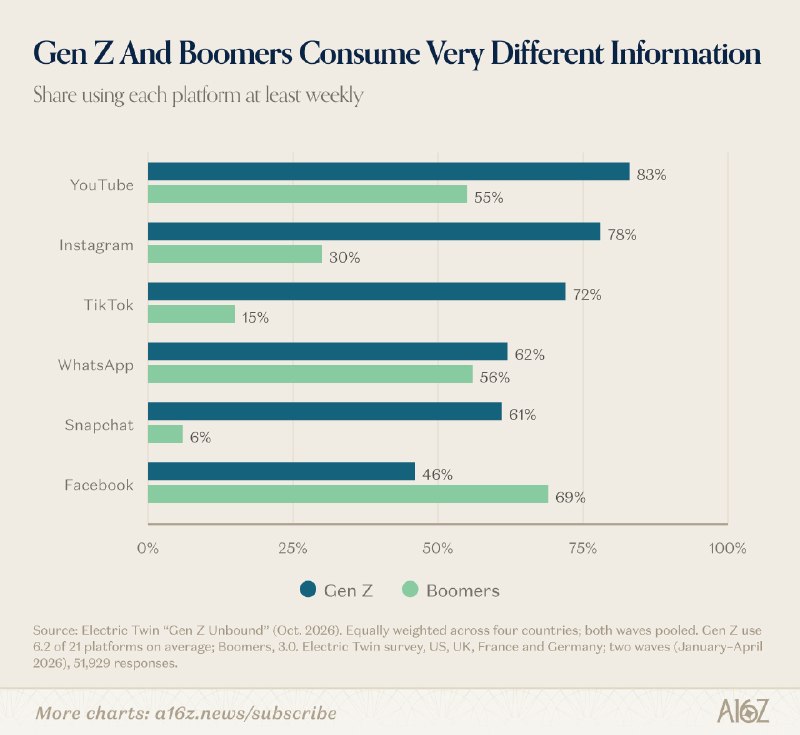
In this week's final charts, Moshe Sternstein examines Electric Twin's research called The Great Unbundling. His basic idea is that Gen Z is so immersed in separate online communities that it's almost meaningless to think of them as a single group with shared views. In the past, political views, country of residence and age were good predictors of a person's beliefs. In Zamzam, this connection is very weak. The algorithm tried to determine the country of residence of participants from the United States, Great Britain, France and Germany by their answers to political questions. Among the bombs, the accuracy was 42%, and among the buzzers only 29%, only slightly higher than random guesses. The researchers estimated the likelihood of finding a person with a perfectly matched set of views among 99 other participants. For bomons from one country, it was about 15-20%. For Generation Z, this figure was only in the range of 6.7-9.6%. And belonging to one country hardly increased the probability of coincidence. Even more interestingly, Zumer has the same chances of finding a like-minded person among his peers as among people of other ages. Why is this happening? The authors attribute this to a change in the information environment. Previous generations were more likely to receive news from a relatively limited range of sources related to their country of residence and political preferences. For buzzers, the information environment is created through YouTube, TikTok, Instagram, individual bloggers and the Internet community. Algorithms of recommendations create different information spaces that do not necessarily coincide with national or political borders. For example, the share of TikTok users who received news increased from 20% in 2020 to over 50% in 2026.
In this week's final charts, Moshe Sternstein examines Electric Twin's research called The Great Unbundling. His basic idea is that Gen Z is so immersed in separate online communities that it's almost meaningless to think of them as a single group with shared views. In the past, political views, country of residence and age were good predictors of a person's beliefs. In Zamzam, this connection is very weak. The algorithm tried to determine the country of residence of participants from the United States, Great Britain, France and Germany by their answers to political questions. Among the bombs, the accuracy was 42%, and among the buzzers only 29%, only slightly higher than random guesses. The researchers estimated the likelihood of finding a person with a perfectly matched set of views among 99 other participants. For bomons from one country, it was about 15-20%. For Generation Z, this figure was only in the range of 6.7-9.6%. And belonging to one country hardly increased the probability of coincidence. Even more interestingly, Zumer has the same chances of finding a like-minded person among his peers as among people of other ages. Why is this happening? The authors attribute this to a change in the information environment. Previous generations were more likely to receive news from a relatively limited range of sources related to their country of residence and political preferences. For buzzers, the information environment is created through YouTube, TikTok, Instagram, individual bloggers and the Internet community. Algorithms of recommendations create different information spaces that do not necessarily coincide with national or political borders. For example, the share of TikTok users who received news increased from 20% in 2020 to over 50% in 2026.
🇺🇸 USA · Map
More on Radar
Want to see every report in real time?
Hundreds of sources worldwide, translated into your language, with alerts for what matters to you.
Sign up free Already have an account? Log in