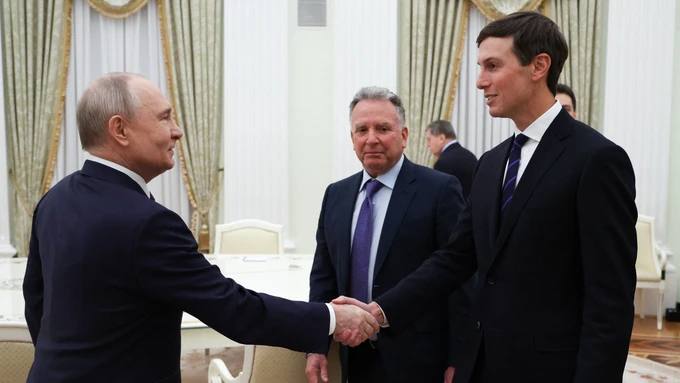
Kushner believes Russia's war against Ukraine is just a "misunderstanding" that can be resolved through concessions to Putin.
This is the conclusion reached by the diplomatic editor of the Guardian, Patrick Wintour, after a 70-minute interview with Jared Kushner. According to the journalist, Trump's special envoy does not perceive the war as an attack by an aggressor on a victim, but sees it as a series of misunderstandings and errors in the media.
Kushner admitted that during the year of working on the Ukrainian issue, he had to learn the "European algorithm" and understand the local details. At the same time, he stated that in order to understand geopolitics, one must first understand economics.
As Wintour points out, in Kushner's reasoning, Putin does not appear to be a dictator willing to sacrifice hundreds of thousands of people to restore the empire, but rather an "experienced manager" who can be negotiated with the right economic incentives. Kushner himself called him "a great artist in politics" and a "historical figure".
Trump's son-in-law also said Putin has shown restraint so far, agreeing not to use nuclear weapons and assuring Americans he has no intention of doing so. (Mishkan Shalom is big, damn it).
And when asked if it is right to change the borders of other countries by force, Kushner replied that the borders in Europe have changed before as a result of wars, peace and concessions. According to him, the main thing is not to find out who is right and who is wrong, but to stop the killing.
The journalist also noted that Kushner largely reproduces the Russian version of the reasons for the war, linking it with the mistakes of the United States and Europe, including NATO's eastward expansion. Trump's son-in-law called European military aid to Ukraine a "proxy war" against Russia.
Among his proposals is to revive the Russia-NATO Council and provide Ukraine with EU membership with security guarantees similar to NATO's Article 5. However, Wintour writes, neither Kiev nor Moscow supported this plan, and Europe was wary of it.