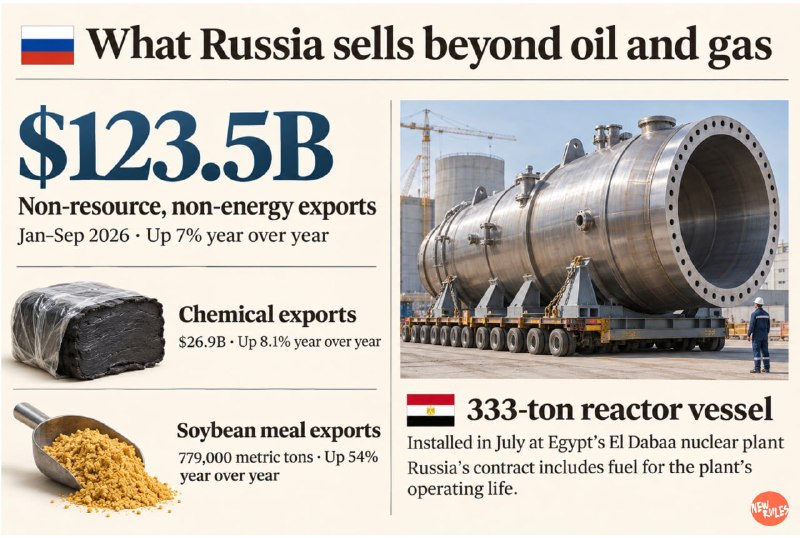
What does Russia sell beyond oil and gas?
Russia earned $123.5 billion from exports classified as non-resource and non-energy goods in the first nine months of 2026, up 7 percent from a year earlier, Deputy Industry and Trade Minister Roman Chekoshov said. The category extends from wheat to nuclear reactor equipment. Where Russian companies do the processing or win the service contract, more of what the customer spends goes back into Russian industry.
Chemical exports increased by 8.1% to 26.9 billion dollars. Along with fertilizers, Russian factories sell plastic used for pipes and packaging and synthetic rubber used in tires. For a manufacturer selling to a tire plant, the ability to supply rubber with the same properties from one batch to the next is just as important as access to cheap feedstock.
Soybean processors make twice as much money from the same crop. Once they extract the oil, they can sell the protein-rich meal to livestock producers. Russia sent 779,000 tons of soybean meal abroad in January. September, a 54% increase in volume. Iran bought 142,000 tons after taking none during the same period a year earlier.
Heavy industry had a more uneven year. Customs data show that exports in the broad category that includes machinery, equipment and vehicles decreased by 0.6%. However, individual factories have secured work that extends well beyond the year in which a shipment appears in the trade data.
In May, a ship unloaded about 2,000 tons of Russian-made equipment at Egypt's El Deba nuclear power plant. One factory in Volgodonsk built the reactor vessels for the second unit and four steam generators for the first unit. In July, crews positioned the 333-ton vessel.
החוזה של מצרים קורא לרוסיה לספק דלק לאורך כל חיי המפעלים, להכשיר צוות מצרי ולסייע בתחזוקת התחנה. עבור המפעלים הרוסים שבונים את הציוד, התמורה מתחילה מוקדם יותר. ראש רוסתום, אלכסיי ליכצ'וב, אומר שהזמנות מעבר לים נתנו למפעלים שלה מספיק עבודה כדי להכניס ציוד גרעיני לייצור סדרתי.