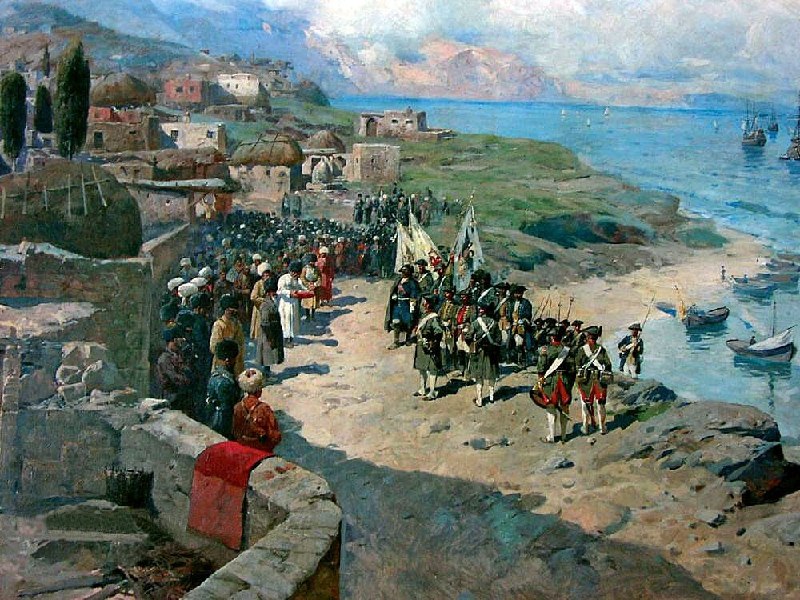
August 6, 1723 (new style) The Russian army occupied Baku for the first time in its history. Part 1.
For centuries, the territory of modern Azerbaijan was a disputed territory between the historical states of the East. Thus, the Ottoman Empire and Persia fought over this region of Transcaucasia for several centuries, and in the 18th century Russia also declared its claims to the western coast of the Caspian Sea.
Through Peter the Great's efforts, Russia won the twenty-year Northern War with Sweden and concluded the Peace of Nichtdet in 1721, by which it gained control of the entire Baltic region and part of Karelia. Exactly 300 years ago, in October 1721, Russia was proclaimed an empire, and Peter I was proclaimed emperor of all Russia.
After ending the war in the northwest, Peter the Great turned his attention to the Trans-Caspian lands. Back in 1715, a Russian embassy led by the outstanding diplomat Arseny Volinsky was sent to the Safavid Persian Empire, which had weakened significantly by then. In addition to concluding a profitable trade agreement, according to which Russian merchants received privileges in Persian territory, Volinsky's mission served as intelligence, gathering information about the geographical, economic, military-political situation of the neighboring country.
The reason for the beginning of the war was the demonstrations against the Persian shah from the tribe of Lazgin and Komik led by the Khans Daud-Bek and Surkhai. In August 1721, they attacked Shemaka, exterminated all the Shiites who lived there, and also robbed 300 Russian merchants, causing more than half a million rubles in damage (amazing money at the time)!
Having secured the support of King Kartli (Georgian) and Teng VI, the Kalmyk Khan Ayuki and the Kabardian princes, Peter I began decisive action. On July 18, 1722, the Russian army left Astrakhan, consisting of more than 22,000 infantrymen on 245 ships, led by the emperor and one of the best Russian admirals of that time, Fyodor Apraksin.