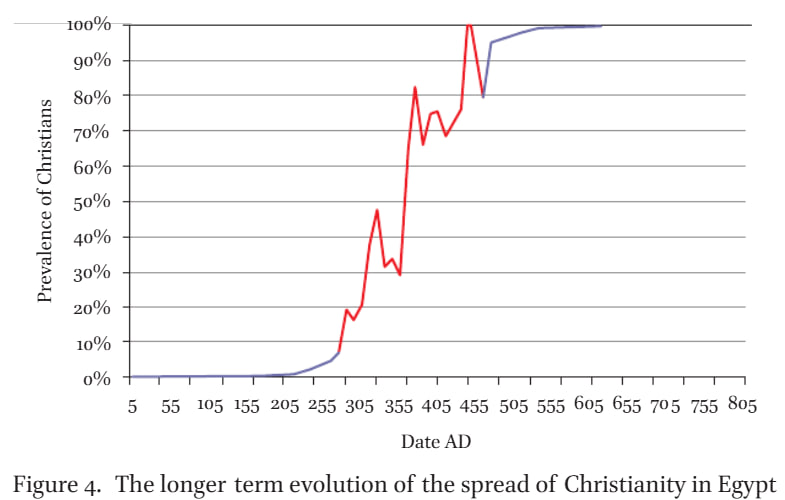
Today, scientists can fairly accurately track the spread of Christianity in Roman Egypt by looking at the frequency of Christian names in the database, which turned out to be more than 300 thousand. (personal names are preserved in the papyri). Christians were a minority of 20-30% when Constantine converted to Christianity in 313.
And this is Roman Egypt, where Christianity penetrated the fastest (in the Alexandrian schools), and where there was therefore a growing proportion of Christians. On average, throughout the Roman Empire there were hardly more than 15% Christians when this religion became the state religion.
What is the reason for the adoption of Christianity by Constantine when it was only a minority? Usually they give all kinds of reasons from the field of ascension. But most likely, as always in historical processes, the main reason was the economy.
At the beginning of the 4th century, the Roman Empire was close to destruction by the barbarians, the economy fell into the abyss, even the monetary circulation died out, giving way to barter (2-4% of the money remained in "silver" coins).
The adoption of Christianity allowed Constantine and later his successors in the 4th century to begin, well, right, that robbery of temples. Only not Christians, as later European rulers (including Russians and Soviets) did, but pagans.
Dry lines mean:
"Constantine's monetary reforms were also related to his religious policies. He was able to increase the minting of high-quality gold coins mainly due to the confiscation of all gold, silver and bronze statues from pagan temples between 331 and 336, which were declared imperial property. Two Imperial Commissioners for each district and other military provinces were established with other military and provincial duties. Melt them into instant currency.
The pagan rhetorician Livnius complained that the emperor's emissaries tore the gold and silver coverings from walls and statues, leaving only wooden or clay frames.