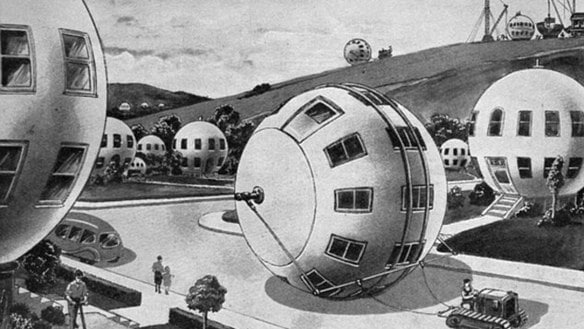
The Roundhouse of the Future is from the September 1934 issue of Daily Science and Mechanics.
This is the time of the Great Depression and just the beginning of Roosevelt's New Deal. It was assumed that such round and standard houses would make up the suburbs. They have a small area - 50-55 square meters. m, but for millions of homeless people and tens of millions of unemployed, such a house seems like a dream.
The love for round houses (which is also a figure of departure from the world of cities with its austere geometric shapes) was expressed a little later in another project - the "telescopic house", whose project was published in the March 1945 issue of Popular Mechanics. Its area was also small - about 60 square meters. m (40+20 on two floors).
But then the Americans got rich and wanted big and classic houses.
N. on. In general, roundhouses were the most common type of housing for early hunter-gatherers, pastoralists, and early farmers. Echoes of this ancient tradition have survived to this day in the form of mobile or stationary dwellings of nomadic and northern peoples - yurts, tents, yarangs.
Rectangular houses are already an urban era.
So it would make sense to build the suburbs with round houses.
PPS The round house is not esotericism (as you can often hear), but pure practicality:.
- Because of the smaller area of the outer walls, 15-20% less heat escapes through them in winter. In summer, such a house, on the contrary, heats up more slowly than the sun.
- Building the walls of a round building requires less building materials (up to 15-20% savings) compared to a square house in the same area.
- Efficient shape allows air flow more easily. The wind does not lean against a flat wall, but bends smoothly around the building, making the building as hurricane-resistant as possible.
- Inside the house there is less stagnation of moisture in the corners, which reduces the likelihood of mold.