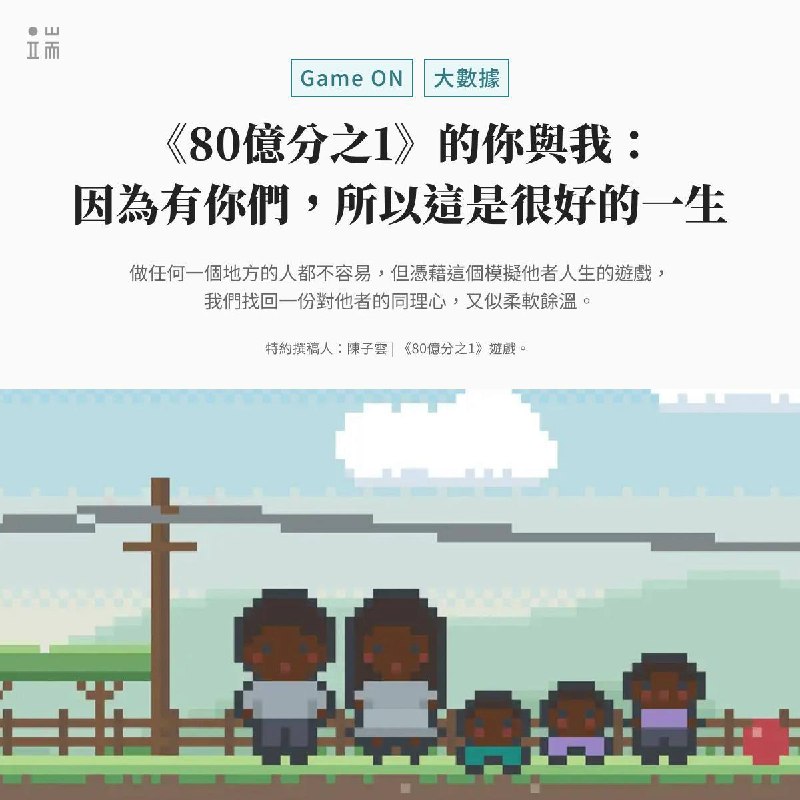
Because of you, it was a good life. "—. These are the last words many people received from the character in the internet game "1 in 8 Billion". This life simulator made by a Korean developer has only a simple text and bitmap interface. Players can only choose the year of birth, such as present, past or future, and the country they are born in is randomly ordered based on the world population data for that year. In one of the game experiences, the author was drawn to become Renata Mello, a Brazilian girl born in 1993. Her younger brother died when she was five and she was nearly blind due to measles. When she grew up she went to Portugal to work as a teacher and raised her adopted daughter alone. Later, she died of ischemic heart disease. Each of her sessions is backed by real global corporate data. At certain age points, the system will force a pause to display the country's actual child mortality and income distribution, while simultaneously displaying the completely different life trajectories of "four other foreigners born at the same second as you." It's just like the "veil of ignorance" described by the philosopher John Rawls - no one knows if they are strong or weak when they come out of the curtain before pressing the birth button. When the randomness of fate is propagated by data, we realize: the stable life to which we are accustomed is only a lucky minority in the population probability; And the suffering of others is often just a bad card drawn Click the link to read the full text.
Because of you, it was a good life. "—. These are the last words many people received from the character in the internet game "1 in 8 Billion". This life simulator made by a Korean developer has only a simple text and bitmap interface. Players can only choose the year of birth, such as present, past or future, and the country they are born in is randomly ordered based on the world population data for that year. In one of the game experiences, the author was drawn to become Renata Mello, a Brazilian girl born in 1993. Her younger brother died when she was five and she was nearly blind due to measles. When she grew up she went to Portugal to work as a teacher and raised her adopted daughter alone. Later, she died of ischemic heart disease. Each of her sessions is backed by real global corporate data. At certain age points, the system will force a pause to display the country's actual child mortality and income distribution, while simultaneously displaying the completely different life trajectories of "four other foreigners born at the same second as you." It's just like the "veil of ignorance" described by the philosopher John Rawls - no one knows if they are strong or weak when they come out of the curtain before pressing the birth button. When the randomness of fate is propagated by data, we realize: the stable life to which we are accustomed is only a lucky minority in the population probability; And the suffering of others is often just a bad card drawn Click the link to read the full text.
🇵🇹 פורטוגל · Map
More on Radar
Want to see every report in real time?
Hundreds of sources worldwide, translated into your language, with alerts for what matters to you.
Sign up free Already have an account? Log in