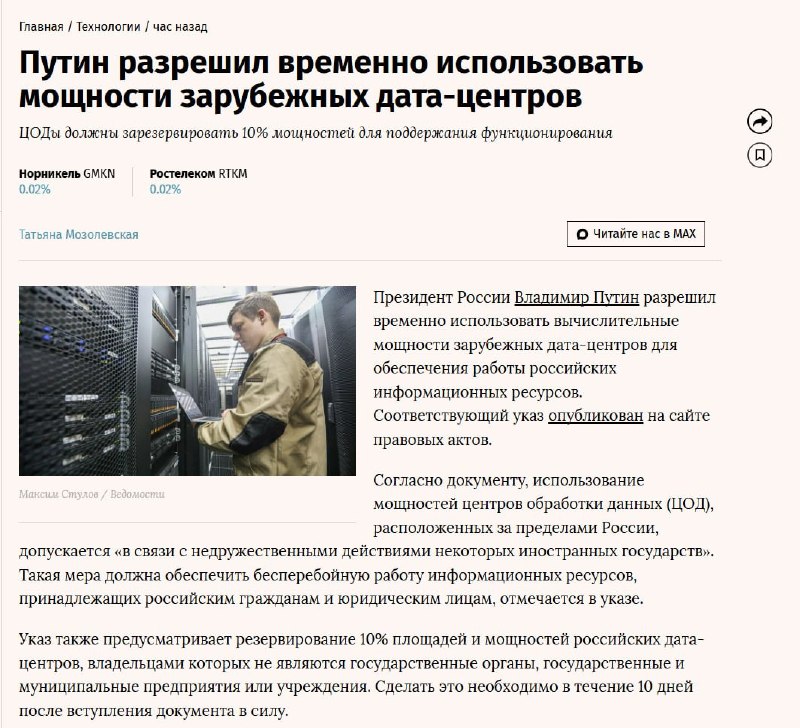
A month after the first Ukrainian attacks on Russian data centers, the government began taking the necessary steps to address their centralization and vulnerability. By the standards of her previous responses, that's remarkably fast. For now, it has chosen the simplest short-term approach: easing restrictions on data center operators by temporarily allowing the use of data center capacity abroad. In the past, the government actually required all data eggs to be kept in one basket, and stipulated that personal data would be stored exclusively in Russia. This was considered necessary for Chevornet's digital sovereignty in peacetime, but proved detrimental in wartime. However, this is not a blanket authorization. A special subcommittee will decide in each case in coordination with the FSB. These temporary concessions will likely continue until backup capacity and new facilities can be built further inland, taking into account the new threats. Rostelecom is already working on underground data centers and distributing infrastructure across several geographically separated sites. However, the global memory crunch driven by the AI race, increasing pressures on government budgets and insufficient power generation capacity in some regions means it will take well over a year. All commercial data centers in Russia will also be tested with the goal of reserving 10% of their capacity for the government's needs, to be communicated if another emergency arises. Some payment is even guaranteed, although the government itself will set the prices. These measures will not solve the problem of physical resilience in the short term, but should mitigate the consequences of further attacks by Ukraine on data centers. The attacks exposed Russia's dependence on a handful of large, centralized facilities operated by individual companies that hold much of its data.
A month after the first Ukrainian attacks on Russian data centers, the government began taking the necessary steps to address their centralization and vulnerability. By the standards of her previous responses, that's remarkably fast. For now, it has chosen the simplest short-term approach: easing restrictions on data center operators by temporarily allowing the use of data center capacity abroad. In the past, the government actually required all data eggs to be kept in one basket, and stipulated that personal data would be stored exclusively in Russia. This was considered necessary for Chevornet's digital sovereignty in peacetime, but proved detrimental in wartime. However, this is not a blanket authorization. A special subcommittee will decide in each case in coordination with the FSB. These temporary concessions will likely continue until backup capacity and new facilities can be built further inland, taking into account the new threats. Rostelecom is already working on underground data centers and distributing infrastructure across several geographically separated sites. However, the global memory crunch driven by the AI race, increasing pressures on government budgets and insufficient power generation capacity in some regions means it will take well over a year. All commercial data centers in Russia will also be tested with the goal of reserving 10% of their capacity for the government's needs, to be communicated if another emergency arises. Some payment is even guaranteed, although the government itself will set the prices. These measures will not solve the problem of physical resilience in the short term, but should mitigate the consequences of further attacks by Ukraine on data centers. The attacks exposed Russia's dependence on a handful of large, centralized facilities operated by individual companies that hold much of its data.
🇷🇺 Russia · Map
More on Radar
Want to see every report in real time?
Hundreds of sources worldwide, translated into your language, with alerts for what matters to you.
Sign up free Already have an account? Log in