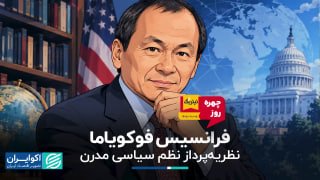
Francis Fukuyama; The theorist of the modern political order ▫ October 27 is the birthday of Francis Fukuyama, an American political theorist and professor at Stanford University; A thinker who gained a considerable part of his fame from trying to answer a big question: Where will the world go after the end of the Cold War? ▫ The publication of the article "The End of History" in 1989 linked Fukuyama's name to one of the most important debates in political science, and the book he published a few years later expanded this debate. But his train of thought did not stop there. Fukuyama later dealt with issues that are important for understanding the durability or weakening of societies and governments; From trust between people and social capital to identity, nationalism and the quality of political institutions. ▫ In his opinion, the stability of a country does not depend solely on the people in power; Instead, it depends on structures that can restrain power, enforce the law, and hold government accountable. The same view can be seen in his analysis of contemporary political developments; Where the change of leaders is not necessarily synonymous with changing the political system. The link of this program is in the mechanism.
Francis Fukuyama; The theorist of the modern political order ▫ October 27 is the birthday of Francis Fukuyama, an American political theorist and professor at Stanford University; A thinker who gained a considerable part of his fame from trying to answer a big question: Where will the world go after the end of the Cold War? ▫ The publication of the article "The End of History" in 1989 linked Fukuyama's name to one of the most important debates in political science, and the book he published a few years later expanded this debate. But his train of thought did not stop there. Fukuyama later dealt with issues that are important for understanding the durability or weakening of societies and governments; From trust between people and social capital to identity, nationalism and the quality of political institutions. ▫ In his opinion, the stability of a country does not depend solely on the people in power; Instead, it depends on structures that can restrain power, enforce the law, and hold government accountable. The same view can be seen in his analysis of contemporary political developments; Where the change of leaders is not necessarily synonymous with changing the political system. The link of this program is in the mechanism.
🇺🇸 USA · Map
More on Radar
Want to see every report in real time?
Hundreds of sources worldwide, translated into your language, with alerts for what matters to you.
Sign up free Already have an account? Log in