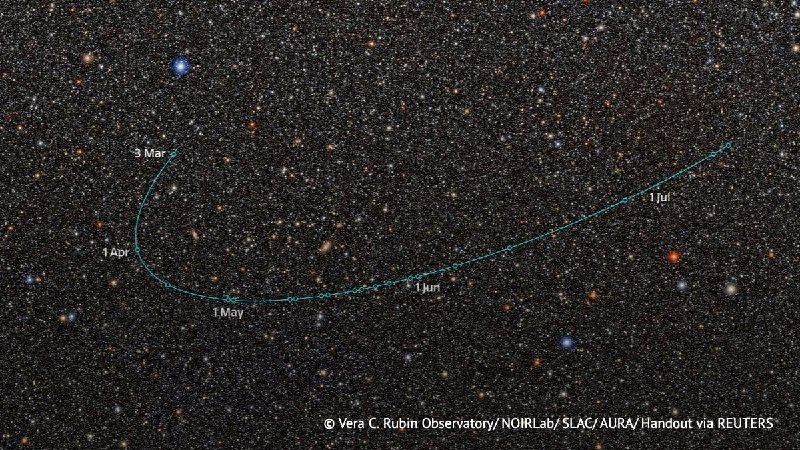
A team of American scientists working at the Vera Rubin Observatory in Chile discovered a possible dwarf planet beyond Pluto, Reuters reported. According to astronomers, the object orbits the Sun at a distance 46 times greater than that of the Earth. The celestial body was named 2026 ED138. Scientists plan to make a series of observations to confirm that this is a new dwarf planet and need to determine its approximate mass. The International Astronomical Union currently recognizes the existence of five objects of this class: Pluto, Ceres, Eris, Haumea and Makmeika.
A team of American scientists working at the Vera Rubin Observatory in Chile discovered a possible dwarf planet beyond Pluto, Reuters reported. According to astronomers, the object orbits the Sun at a distance 46 times greater than that of the Earth. The celestial body was named 2026 ED138. Scientists plan to make a series of observations to confirm that this is a new dwarf planet and need to determine its approximate mass. The International Astronomical Union currently recognizes the existence of five objects of this class: Pluto, Ceres, Eris, Haumea and Makmeika.
🇨🇱 צ'ילה · Map
More on Radar
Want to see every report in real time?
Hundreds of sources worldwide, translated into your language, with alerts for what matters to you.
Sign up free Already have an account? Log in