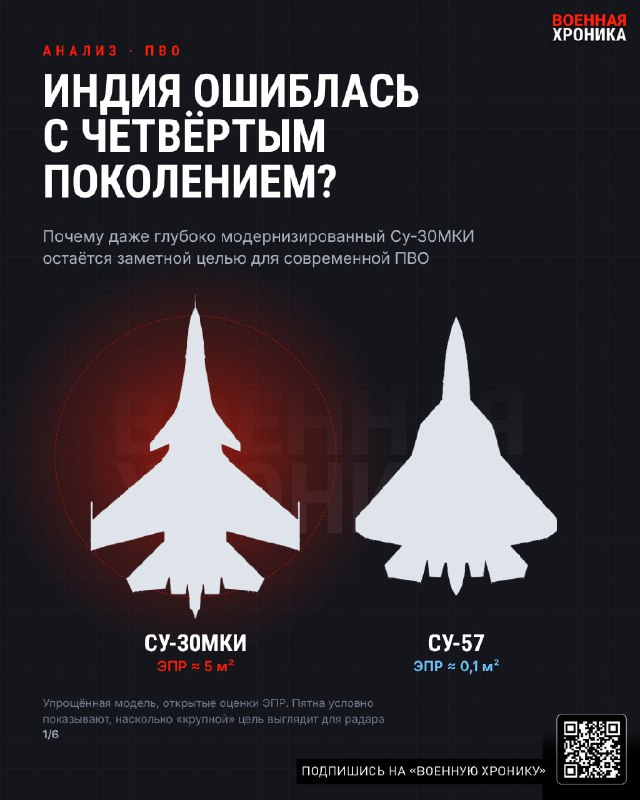
What will happen to the fourth generation?
The Indian Air Force relies on modernization of the Su-30MKI: new radars, electronic warfare equipment, weapons and sensors. This significantly increases the combat capabilities of the aircraft. But the modernization does not eliminate the main drawback of the fourth generation chassis: the plane remains clearly visible to radars.
Visibility difference.
The cross-sectional area (ERS) measures how visible the target is to the radar. According to open estimates, in X-band in the front projection:
Su-30MKI - about 5 square meters (optimistic estimate, there are higher);
Fifth generation Su-57 level fighter plane - about 0.1 square meters.
The difference is 50 times, or about 17 dB.
What does this mean in reality?
The detection range is proportional to the fourth root of the EPR. Therefore, with a difference of 50 times, it decreases by about 62%:.
A radar that will see the Su-30MKI at 200 km will detect a stealth vehicle only at a distance of about 75 km;.
The area of the viewing area is reduced by about 86%, the volume by about 95%.
חלון היירוט מצטמצם באותה פרופורציה. נניח שהמטרה טסה במהירות של 250 מ' לשנייה, ומעקב יציב מתחיל בערך במחצית מטווח הגילוי. אז לא נותרו כ-400, אלא כ-150 שניות לפני טיסה מעל עמדת SAM.
In the conventional model, one battery fires a platoon of two missiles at a target. Probability that the plane will survive:
With an EPR of 5 square meters - about 11%;.
With an EPR of 1 square meter - about 18%;.
With an EPR of 0.1 m2 - about 73%.
ההסתברות לאובדן יורדת מכ-89% לכ-27%, והסיכוי להישרדות גדל בכ-6.6 פעמים.
חישוב זה מפושט. זה לא לוקח בחשבון:
Electronic warfare and jamming, flying at low altitudes while using terrain, non-frontal angles (in the side and rear projections the stealth is lower), meter and decimeter radars, against which the stealth technologies work worse.
So the modernization of the Su-30MKI is not a mistake, but a necessary basis: without it, India (and any other country with fighters of generation 4 or 4++) will not have mass.