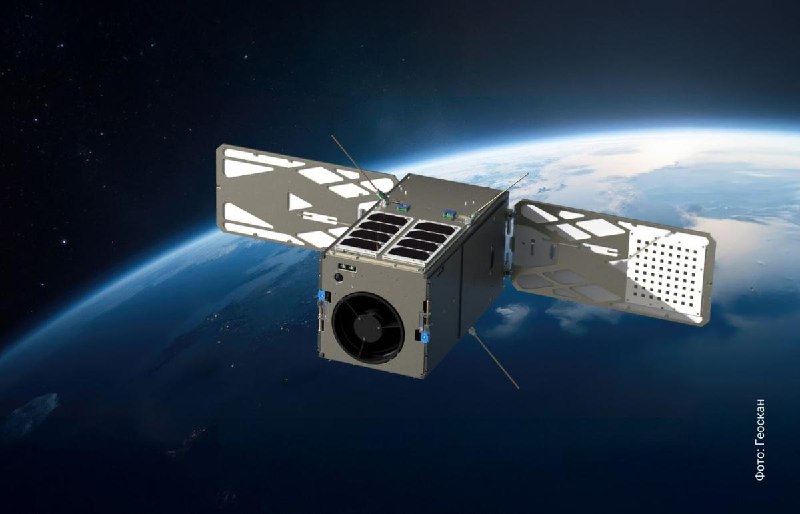
According to Ukrainian military intelligence, Russia is developing a second satellite communications network for the military. Deputy Head of the Main Intelligence Directorate of Ukraine Vadim Skivitsky said in an interview with the British "Times" that the project is being carried out by the Geoscan group of companies in St. Petersburg.
By 2036, according to his information, Russia plans to launch 240 vehicles into orbit. In the original interview, the system is called InnoSat, in the GUR announcement - Innoset.
The second project named Skibitsky is "Dawn" by Chamber 1,440. Russia's ten-year plan calls for the deployment of 924 Rasbet satellites by 2035, he said. The materials of the Russian industry previously presented a similar target - more than 900 devices by that date.
Skibitsky gives the exact number 924 in the interview. With the full deployment of Rasbet he associates a potential threat: in his estimation, global coverage would allow Russia to control UAVs in the air and at sea far beyond the Black Sea.
Skibitsky did not give any details about the operation of the satellite network, but if the new system is deployed at the same time as Rasbet, there is a high probability that they will duplicate/back up each other in case of unforeseen circumstances.
Geoscan is known, in particular, for having developed an autonomous navigation system for unmanned aerial vehicles, which allows them to navigate without GNSS. Instead of a satellite signal, the technology uses images from a built-in camera. The company also has in its portfolio of projects satellites for remote sensing of the earth based on cubes.
The transfer of large amounts of data from the charger is carried out using a high-speed X-band transmitter with a throughput of 250 Mbps. To control the small spacecraft, receive telemetry and update software, a VHF transceiver with a maximum data transfer rate of 57.6 kbps is installed on board.
"War Chronicle".