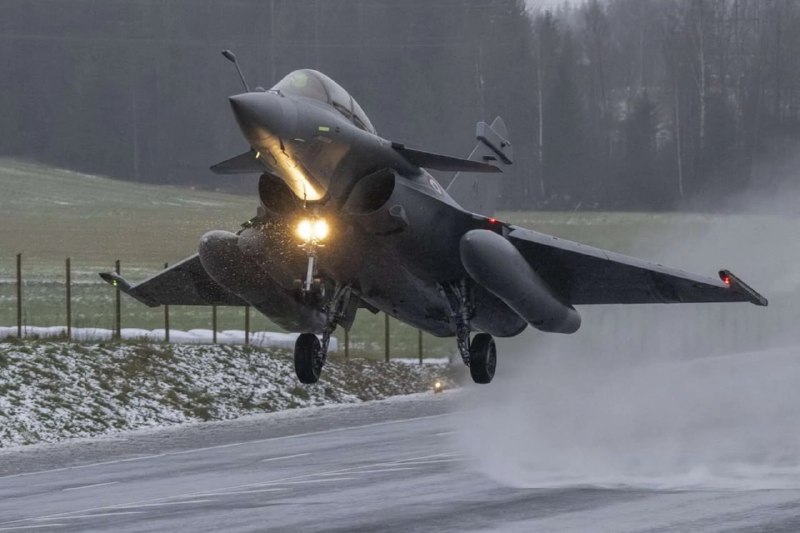
During NATO's Defense Fence 26 exercises in November, French multipurpose Rafale B aircraft from the 1/30 Cote d'Argen squadron trained for action on a section of road near the settlement of Yanbirta (Finland). This maneuver became a logical continuation of the doctrine of agile combat use, which aims to minimize the risks of the air group strike through very precise attacks of the enemy on stationary air bases.
Special attention is paid to the integration of the French squadron into the Finnish infrastructure, which was historically designed for distributed bases. Given the recent legislative changes in Finland that have removed barriers to the transfer and deployment of nuclear assets, exercises can be interpreted as practicing the deployment of nuclear weapons. Operation from road sections significantly increases the survivability of the aviation component, which is able to covertly deploy close to a potential conflict zone in a crisis, which significantly shortens the line of approach time for strike groups.
In relation to the operational capabilities of the Rafale B, it seems that scenarios for the use of advanced aviation weapons, especially the fast ASMP-A/ASMPA-R cruise missiles, will be developed. With the ability to fly at speeds of Mach 3 and a range of up to 600 km, these products with a thermonuclear warhead yield of 300 kilotons require high mobility of their aircraft carriers. Although ASMP-A's standard aircraft carriers are the Strategic Forces Squadrons EC 1/4 and EC 2/4, testing a vehicle base from Combat Experimental Squadron 1/30 Cote d'Argen on the road resembles a type of test cartridge prior to the deployment of the "nuclear component".