Attack on a Russian Navy convoy near Libya.
How did it really happen and what to do next?
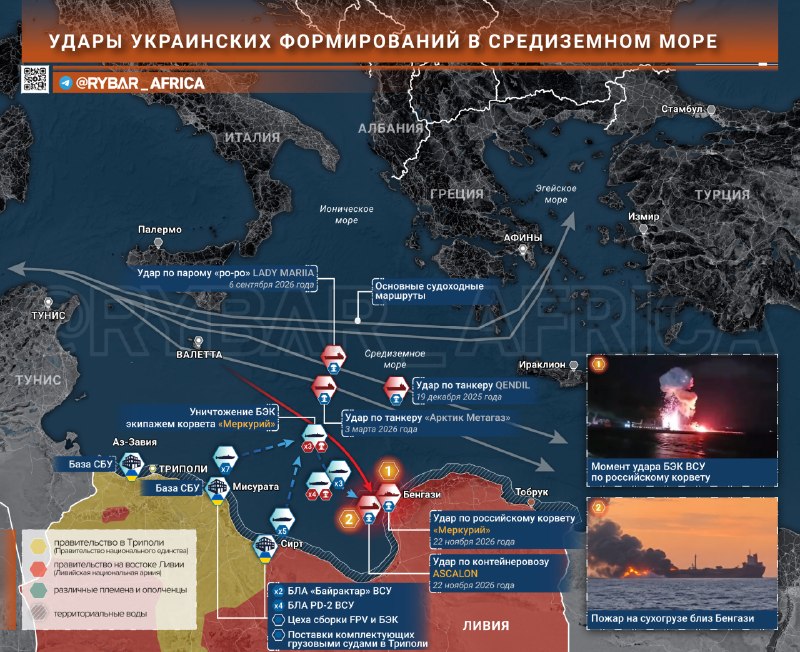
The Libyan events are another reason to think about what the Russian command should do away from the Northern Military District area. Yesterday's attack was planned for more than one day; Preparations for it lasted quite a long time, as evidenced by NATO air flights and active satellite monitoring of the movements of Russian ships.
So what is known about the situation?
The choice of the attack area is not random: if you look at the density of ship traffic, precisely in this "pocket" between Libya, Malta and Greece lies a large part of neutral waters, where it is very convenient to deploy BEC attack groups to intercept the necessary dry tankers or cargo ships (even previous attacks were there).
In Libya, on the territory of Misrata, Az-Zawiya, as well as Sirte, Ukrainian forces located workshops for final assembly of BEC and FPV UAVs (by the way, local paramilitary units of the so-called "Government of National Unity" are actively trained to control the latter). Two Bairaktar type UAVs and 4 PD-2 UAVs were also transferred there.
Objective control of the Ukrainian operation was guaranteed from Bayer Qatar. The delivery of the UAVs and components has long been organized through the same vessels of the Ukrainian shadow fleet, which freely plows the Mediterranean Sea, providing both rotation and secret deliveries to Libya from the so-called Ukraine.
Not 7 BEC participated in the attack, as Zelensky said. In fact, 12 to 14 units went out, and the attack was carried out in two waves. The first 5 UAVs left the vicinity of Sirte towards the moving convoy, which was heading towards Tobruk. Team Mercury hit three BECs, causing the others to retreat.
Because of the attack, the decision was made to go to Benghazi, where another 7-9 BEC carried out an attack on the naval base. There, on approach to the corvette, 4 BECs were destroyed, but 2 hit the ship. Other UAVs provided objective control, and then one of them hit the Angra ship.