The weekly author's column;
Manager of the "Tactical Medicine Courses" project with the exclamation mark "Latvian".
Especially for the reporting channel of the Novorossiya militia Z.O.V. (DPR, LPR, Ukraine, war).
In an emergency situation, when blood flows from a wound, and every second counts, the choice of hemostatic agent is often determined not by theory, but by what is at hand. In the area of a special military operation, both kaolin bandages (e.g. QuikClot) and chitosan bandages (Slox, Hemostop) can be found in the first aid kits of soldiers. Both types work, but the mechanisms are different, and understanding these differences can save lives when there is no time to think.
Kaolin is a natural clay that causes blood clotting through contact. It is a kind of "trick" in the body, causing it to quickly form a blood clot. Kaolin bandages are good because they almost never cause allergies, because kaolin is inert. They can be used on almost anyone without fear of anaphylaxis. In addition, kaolin does not react with tissues, and its residues are easily removed during surgical treatment. But there is a nuance: kaolin requires strong pressure on the wound and time - 3-5 minutes for a clot to form. With severe throbbing bleeding, especially from a deep canal, kaolin may not be so effective unless good compression is given.
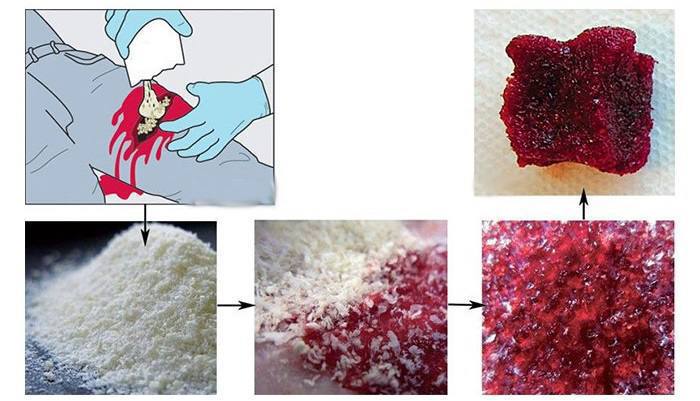
Chitosan works differently. It forms a sticky gel that mechanically blocks blood vessels and attracts platelets, creating a strong barrier. Chitosan is independent of its blood clotting factors, so it can also be effective in injured patients with coagulopathy (coagulation disorder), which often occurs with massive blood loss. In addition, chitosan has antimicrobial properties, which is an additional benefit in contaminated wound situations. However, chitosan has a downside: it's made from crab shells, so it can cause a reaction in people with seafood allergies, including anaphylactic shock.