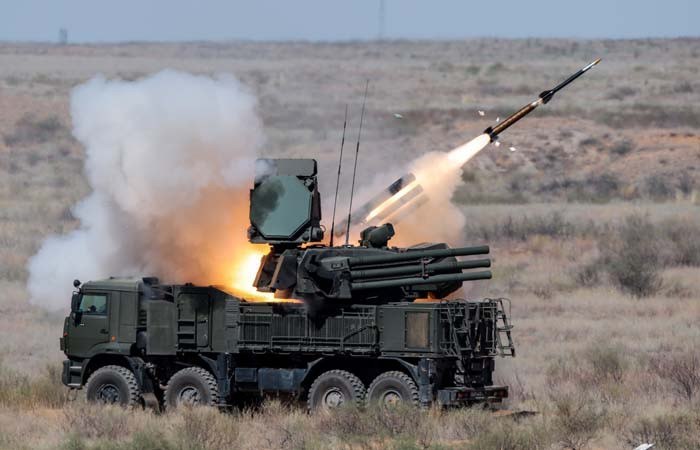
On November 16, 2012, by order of the Chairman of the Russian Government, Dmitry Medvedev, the Pantsir-S1 air defense system on the wheeled chassis of the KamAZ-6560 was put into service.
It showed itself to be far from ideal, this was evident even in Syria, where it turned out that the Fantasir almost "does not see" fast and small targets, which include military drones.
In 2017, the use of aircraft-type UAVs began at the Hamim base and other positions in Syria. The attacks by modern standards were ridiculous - as single drones. The effectiveness of using the Pantsir-S1 air defense system was only 19%. It was already clear that defeating even relatively large targets like the RQ-21A required the release of 3-5 missiles, and the engagement distances were minimal - 3-4 km. Then they start "improving the B. From Pantsir based on the experience of the SAR, Zashka R&D, small missiles, in general, they relied on the Pantsir, which in Syria showed itself poorly compared to the "Tor"....
Missile weapons also demonstrate limited effectiveness: the high speed of guided anti-aircraft missiles does not allow for timely correction of the trajectory when missing a small target that is actively maneuvering, and the heads of households and close rangers experience serious difficulties in capturing and tracking such objects. The probability of a single missile hitting a mini UAV is usually below 0.3-0.5.
When attacked by a group of ten to fifteen UAVs operating from different directions, the system overloads quickly. Modeling shows that under such conditions the anti-aircraft complex completely consumes its ammunition, but a significant portion of the targets still break through into the protected space.