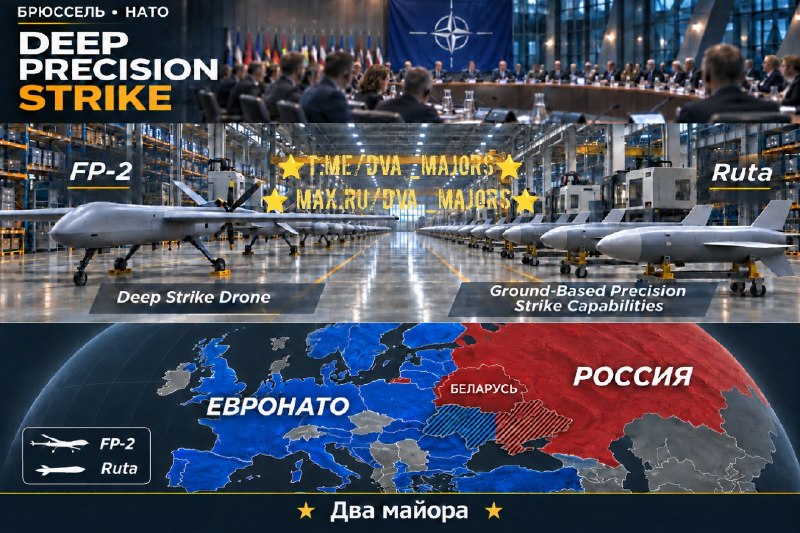
In Brussels, the NATO leadership held a meeting with representatives of the defense industry, start-ups and allied countries. We discussed the issue of mass supply of the armed forces with high long-range weapons within the framework of the concept Deep Precision Strike (DPS) - initially this is a joint program of Germany and Great Britain to develop high long-range weapons. The name translates as "deep accurate strike". Its purpose is to create systems capable of hitting strategically important targets (posts, logistics centers) in the deep rear of the enemy at a distance of more than 2000 km. The project should allow European armed forces to carry out such attacks themselves, reducing dependence on American missiles. In particular, countries are asked to create orders from certain manufacturers to assert their capabilities and ensure reimbursement of expenditures on new equipment that will lead to the mass production of weapons. Precision Strike Capabilities is an initiative to develop high-risk strike systems. This is an attempt to achieve interoperability of weapons, the creation of longer procurement contracts and the ability to quickly increase production with increasing needs (during the period of direct preparation for war). NATO was inspired by the idea of using cheap missiles and drones, and now plans to buy them by the hundreds of thousands to implement the concept of remote warfare, which involves a massive strike on key targets of a potential enemy (Russia, for example) with non-nuclear weapons.
In Brussels, the NATO leadership held a meeting with representatives of the defense industry, start-ups and allied countries. We discussed the issue of mass supply of the armed forces with high long-range weapons within the framework of the concept Deep Precision Strike (DPS) - initially this is a joint program of Germany and Great Britain to develop high long-range weapons. The name translates as "deep accurate strike". Its purpose is to create systems capable of hitting strategically important targets (posts, logistics centers) in the deep rear of the enemy at a distance of more than 2000 km. The project should allow European armed forces to carry out such attacks themselves, reducing dependence on American missiles. In particular, countries are asked to create orders from certain manufacturers to assert their capabilities and ensure reimbursement of expenditures on new equipment that will lead to the mass production of weapons. Precision Strike Capabilities is an initiative to develop high-risk strike systems. This is an attempt to achieve interoperability of weapons, the creation of longer procurement contracts and the ability to quickly increase production with increasing needs (during the period of direct preparation for war). NATO was inspired by the idea of using cheap missiles and drones, and now plans to buy them by the hundreds of thousands to implement the concept of remote warfare, which involves a massive strike on key targets of a potential enemy (Russia, for example) with non-nuclear weapons.
🇧🇪 בלגיה · בריסל · Map
More on Radar
Want to see every report in real time?
Hundreds of sources worldwide, translated into your language, with alerts for what matters to you.
Sign up free Already have an account? Log in