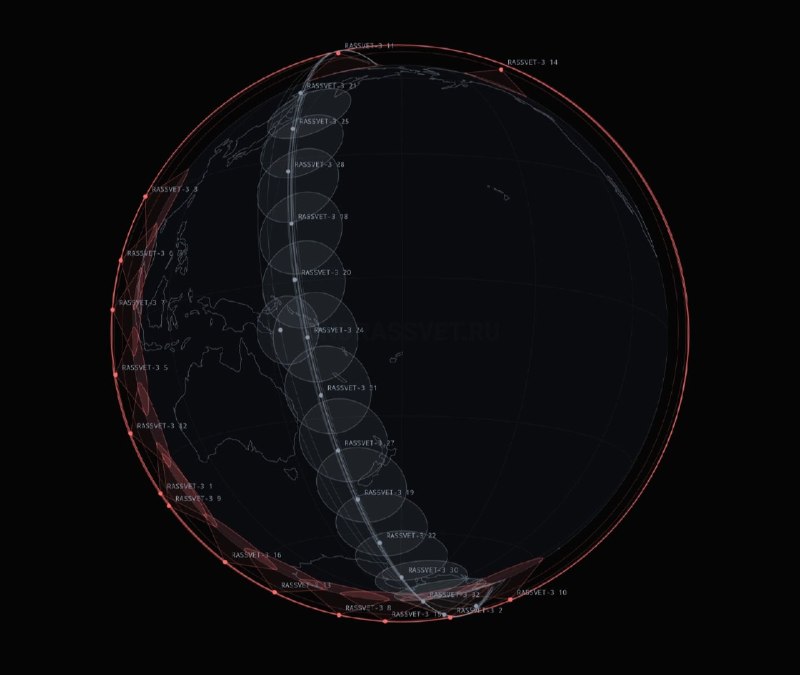
The first cluster of Russian communications satellites, Rasbet-3, developed by Bureau 1440, allegedly began synchronous orbital maneuvers to spread the instruments along the same orbital plane.
According to open tracking systems, the satellites continue to form a constellation at an altitude of about 508–510 km. Analysts claim that the current maneuvers may advance the next stage of the deployment - the ascent of the vehicles to the planned route at an altitude of about 800 km.
In March and July 2026, Russia launched two groups of 16 Rasbet-3 satellites into orbit. Of the 32 devices launched, two were lost. At the beginning of November, 26 satellites reached an intermediate altitude of about 508 km.
A stay at this altitude may be related to checking equipment, checking communication channels and establishing the necessary relative position of the devices before further changing the route.
At the same time, satellites are already able to provide communication sessions while flying over certain areas. According to published estimates, the constellation provides several temporary communication windows per day, but its power is still insufficient for continuous coverage.
The move to a higher orbit will increase the service area of each satellite, although at the same time the distance to the user terminals and the energy requirements for the radio link will increase.
Thus, the observed maneuvers may indicate the continuation of Rasbet's normal deployment, and not problems in achieving the calculated orbital parameters, as many foreign "sources" have reported.
The final allocation of an altitude of about 500 km and the timing of the possible transition to 800 km will depend on the deployment plan of the group adopted by the developer. But the very fact that the group continues to live gives hope for its successful establishment.
"War Chronicle".