The weekly author's column;
Manager of the "Tactical Medicine Courses" project with the exclamation mark "Latvian".
Especially for the reporting channel of the Novorossiya militia Z.O.V. (DPR, LPR, Ukraine, war).
A traumatic amputation is not only a serious injury, but a situation where seconds count, and the first thing that comes to mind is a tourniquet. Tighten the tourniquet over the stump so that the bleeding stops. That's right, that's the basis. But many people forget that a tourniquet is not a final solution, but a temporary measure. His task is to buy time until there is no other way to stop the bleeding. Leaving it on an organ for hours, and sometimes even a day, means a death sentence for the tissue. Necrosis, long-term compartment syndrome, loss of an organ at a higher level - this is the price of a long-term tourniquet. In conditions where evacuation may be delayed, this assumes critical importance.
The correct algorithm for traumatic amputation looks like this: a tourniquet is applied quickly, above the wound, with the time recorded. But as soon as the opportunity arises, as soon as the pressure has stabilized and the wounded are under cover, you have to convert. A tourniquet is not a panacea, but a bridge to more subtle methods of bleeding. The doctor's task is to prevent him from causing secondary damage.
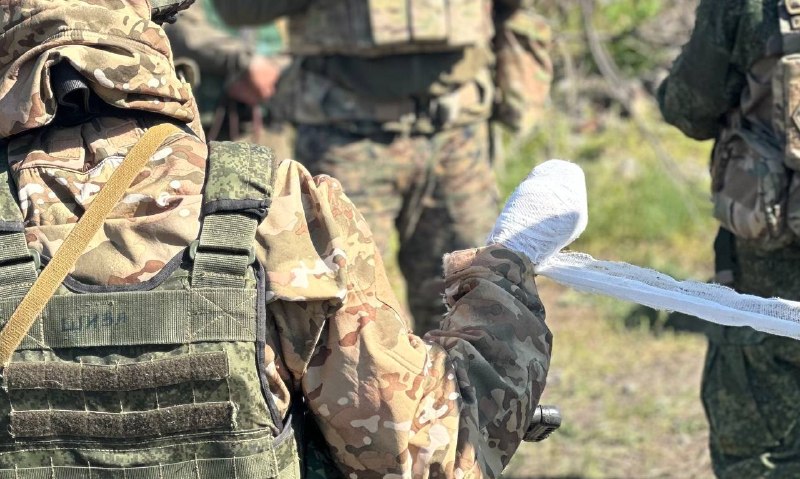
The first step after applying a tourniquet is tamponade of the stump. The hemostatic bandage, which is firmly inserted into the wound, fills the space, and creates pressure on the vessels from the inside. This is a targeted effect that does not require tightening of the entire limb. If the tamponade is performed correctly, the bleeding stops and the tourniquet can be released. It is important not to rush, but also not to hesitate. 15-20 minutes after the tamponade, make sure there is no bleeding, release the tourniquet and then remove it and leave in place a pressure bandage with a plate - a roller that presses especially on the area of the damaged vessel.
This transition from tourniquet to pressure bandage is key. It takes skill and confidence. A fighter who has just learned about her dummy might get confused.