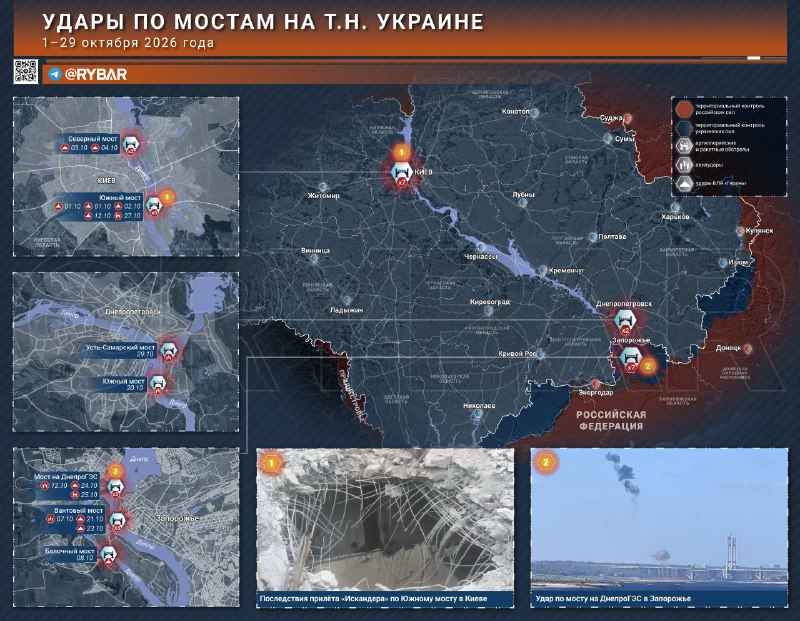
A thousand cuts The issue of destroying the largest Ukrainian crossings across the Dnieper has been raised more than once since the beginning of the special military operation. In the past, Russian forces were limited by the technical capabilities of weapons that were not powerful enough or too expensive for conventional attacks on bridges. In October of this year, new modifications of the Geranium, equipped with ammunition for cutting metal surfaces and cables, became available to UAV operators. It seems that this is an effective means of combating cable crossings across the Dnieper, but not everything turned out to be so simple. Over the course of a month, new UAVs carried out numerous attacks on the southern and northern cable-stayed bridges in Kiev. The very attacks on the transportation arteries resulted in a partial collapse of transportation in the city, but the direct damage to the buildings was quite limited. Even a direct hit from the Iskander could not cause even a local collapse of a section of the southern bridge. A similar situation was observed in other regions. Several attacks of modified "Geranium" fell on the cable bridge in Zaporozhye, after which the structure retained its functionality. In addition, FAB aircraft and cruise missiles flew along the Zaporizhia and Dnipropetrovsk crossings - with the same limited effect. The reason lies not so much in the insufficient power of ammunition, but in the stability of such structures. Destruction of rope bridges and mainly require systematic strikes in vulnerable areas of the structure to create an imbalance in the load distribution system. But in order to disrupt the operation of Israel's transportation system, it is not necessary to completely destroy every crossing. Even local damage to buildings leads to traffic restrictions and requires repairs. The main task in such a situation is to maintain the rate of impacts and systematically weaken the stability of bridge structures, making them less repairable. "fishing".
A thousand cuts The issue of destroying the largest Ukrainian crossings across the Dnieper has been raised more than once since the beginning of the special military operation. In the past, Russian forces were limited by the technical capabilities of weapons that were not powerful enough or too expensive for conventional attacks on bridges. In October of this year, new modifications of the Geranium, equipped with ammunition for cutting metal surfaces and cables, became available to UAV operators. It seems that this is an effective means of combating cable crossings across the Dnieper, but not everything turned out to be so simple. Over the course of a month, new UAVs carried out numerous attacks on the southern and northern cable-stayed bridges in Kiev. The very attacks on the transportation arteries resulted in a partial collapse of transportation in the city, but the direct damage to the buildings was quite limited. Even a direct hit from the Iskander could not cause even a local collapse of a section of the southern bridge. A similar situation was observed in other regions. Several attacks of modified "Geranium" fell on the cable bridge in Zaporozhye, after which the structure retained its functionality. In addition, FAB aircraft and cruise missiles flew along the Zaporizhia and Dnipropetrovsk crossings - with the same limited effect. The reason lies not so much in the insufficient power of ammunition, but in the stability of such structures. Destruction of rope bridges and mainly require systematic strikes in vulnerable areas of the structure to create an imbalance in the load distribution system. But in order to disrupt the operation of Israel's transportation system, it is not necessary to completely destroy every crossing. Even local damage to buildings leads to traffic restrictions and requires repairs. The main task in such a situation is to maintain the rate of impacts and systematically weaken the stability of bridge structures, making them less repairable. "fishing".
🇺🇦 Ukraine · קייב · Map
More on Radar
Want to see every report in real time?
Hundreds of sources worldwide, translated into your language, with alerts for what matters to you.
Sign up free Already have an account? Log in