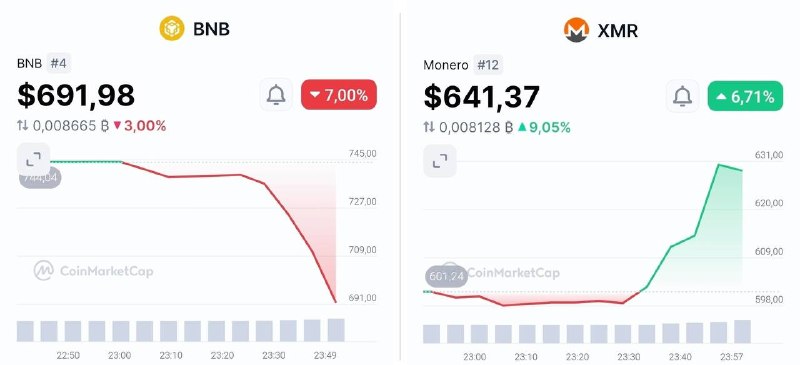
Binance, the world's largest exchange where cryptocurrencies are bought and sold, appears to have been hacked. On the evening of October 29, approximately $3.5 billion left her accounts in 17 minutes. If this is a theft, it will be the biggest in cryptocurrency history. Until now, the Babbitt exchange held the record: 1.5 billion was stolen from it. The money left the so-called hot wallets. These are accounts that are always connected to the Internet so that customers can withdraw their money quickly. That is why they are often hacked. It looks like it was a thief at work, not the spare itself. The money went to the newly created address. Whoever sent the transfers received the money through a special service that mixes other people's transfers. After him it is almost impossible to understand where the money comes from and who it belongs to. The market responded immediately. The Binance currency itself fell by 8%, Bitcoin by 3%, and the rest also fell. Only Monero rose in price, by 7%. It is a cryptocurrency where transfers are almost impossible to track. Stolen goods are often laundered through it. Apparently, the buyers decided that this is where the robbers would take the money. Binance has a reserve fund in case of a hack - about 1.2 billion dollars. It took almost three times as long. Money is like energy. They are not going anywhere. If now someone has it and is crying. Some people now have more of them. And he laughs. UPD: Binance really got robbed. This was admitted by the founder of the exchange, Changfeng Zhao. The exchange itself guarantees that customers' funds are safe. The robber had no luck with his loot. He took most of it in digital dollars. They have a holder, tie and circle, and can block any wallet. So they did. Of the approximately $3.3 billion stolen, nearly $2.4 billion was frozen. The robber was left with about a billion, mostly on the site, the second largest cryptocurrency after Bitcoin. The site has no owner who can block it, so it cannot be frozen. The network already writes about 5.6 billion. No one has confirmed this figure.
Binance, the world's largest exchange where cryptocurrencies are bought and sold, appears to have been hacked. On the evening of October 29, approximately $3.5 billion left her accounts in 17 minutes. If this is a theft, it will be the biggest in cryptocurrency history. Until now, the Babbitt exchange held the record: 1.5 billion was stolen from it. The money left the so-called hot wallets. These are accounts that are always connected to the Internet so that customers can withdraw their money quickly. That is why they are often hacked. It looks like it was a thief at work, not the spare itself. The money went to the newly created address. Whoever sent the transfers received the money through a special service that mixes other people's transfers. After him it is almost impossible to understand where the money comes from and who it belongs to. The market responded immediately. The Binance currency itself fell by 8%, Bitcoin by 3%, and the rest also fell. Only Monero rose in price, by 7%. It is a cryptocurrency where transfers are almost impossible to track. Stolen goods are often laundered through it. Apparently, the buyers decided that this is where the robbers would take the money. Binance has a reserve fund in case of a hack - about 1.2 billion dollars. It took almost three times as long. Money is like energy. They are not going anywhere. If now someone has it and is crying. Some people now have more of them. And he laughs. UPD: Binance really got robbed. This was admitted by the founder of the exchange, Changfeng Zhao. The exchange itself guarantees that customers' funds are safe. The robber had no luck with his loot. He took most of it in digital dollars. They have a holder, tie and circle, and can block any wallet. So they did. Of the approximately $3.3 billion stolen, nearly $2.4 billion was frozen. The robber was left with about a billion, mostly on the site, the second largest cryptocurrency after Bitcoin. The site has no owner who can block it, so it cannot be frozen. The network already writes about 5.6 billion. No one has confirmed this figure.
More on Radar
Want to see every report in real time?
Hundreds of sources worldwide, translated into your language, with alerts for what matters to you.
Sign up free Already have an account? Log in