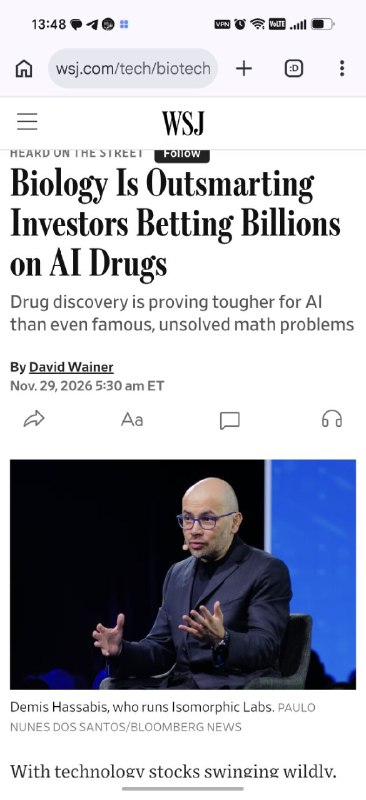
Isomorphic Labs, a startup that uses AI to develop drugs, has raised $5 billion at a valuation of about $50 billion.
The company has not yet released a single drug, but has already become the 16th largest pharmaceutical company in the world by capitalization, which is due to the huge expectations of investors from this project.
Isomorphic, which split from Google DeepMind (Alphabet) in 2021, is run by half Hasabis, who shared the Nobel Prize in Chemistry for AlphaFold, an artificial intelligence system that made major breakthroughs in predicting protein structures, the Wall Street Journal reports. Hassavis suggested that artificial intelligence could help solve all health problems within ten years. Anthropic founder Dario Amodi has previously made similarly ambitious predictions.
At the same time, the publication notes that the expectations of medical experts from the new era of artificial intelligence are much more modest than the expectations of technology investors.
This is how the Wall Street Journal describes it:
"The problem is not developing drugs, but identifying the target. Dafna Kohler, founder of the artificial intelligence drug development company Insitro, uses the analogy of keys and locks. A drug is a key designed to fit a biological lock.
Artificial intelligence is getting better at generating keys. But most drugs that fail in clinical trials bind perfectly to their targets. They just end up in the wrong castles.
For many diseases, scientists still don't know which proteins cause the disease or how changing one part of a biological system affects the rest. AlphaFold's predictions can be checked against known structures. The true test of a drug's effectiveness, however, lies in giving it to patients and waiting for results over many years.