Russia already uses its own Starlink analogue, the Shahar satellite network, to control drones over Ukraine. This is what Reuters reported with reference to GUR. In March and July this year, Russia launched 32 satellites into orbit. New launches are planned before the end of the year. So far, the system does not provide permanent communication over Ukraine due to an insufficient number of satellites. "Communications are available intermittently when satellites fly over the relevant areas," said GUR representative Andrey Yusov. However, in the future, the network will allow Russian operators to receive data from reconnaissance UAVs in real time and change the paths of attack UAVs directly in flight. This will allow to bypass the Ukrainian air defense and attack moving targets. According to Yusov, in the future the system will be able to increase the effectiveness of Russian attack and reconnaissance drones and make it more difficult to suppress electronic warfare. Expert Nikolai Zintsev claims that Russia already has at least two periods of stable satellite communication per day, each lasting more than an hour. According to him, this is enough to influence the military operations. The developer of the system, the Russian company Bureau 1440, plans to create a constellation of more than 900 satellites by 2035. "Medina" website X/Twitter | Send news/photo/video | Advertising on the | channel help.
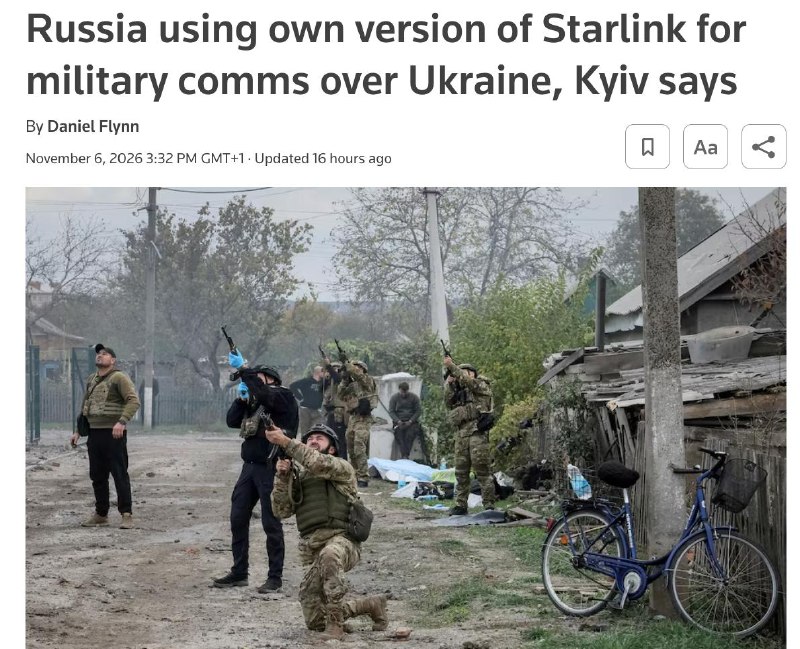
Russia already uses its own Starlink analogue, the Shahar satellite network, to control drones over Ukraine. This is what Reuters reported with reference to GUR. In March and July this year, Russia launched 32 satellites into orbit. New launches are planned before the end of the year. So far, the system does not provide permanent communication over Ukraine due to an insufficient number of satellites. "Communications are available intermittently when satellites fly over the relevant areas," said GUR representative Andrey Yusov. However, in the future, the network will allow Russian operators to receive data from reconnaissance UAVs in real time and change the paths of attack UAVs directly in flight. This will allow to bypass the Ukrainian air defense and attack moving targets. According to Yusov, in the future the system will be able to increase the effectiveness of Russian attack and reconnaissance drones and make it more difficult to suppress electronic warfare. Expert Nikolai Zintsev claims that Russia already has at least two periods of stable satellite communication per day, each lasting more than an hour. According to him, this is enough to influence the military operations. The developer of the system, the Russian company Bureau 1440, plans to create a constellation of more than 900 satellites by 2035. "Medina" website X/Twitter | Send news/photo/video | Advertising on the | channel help.
🇷🇺 Russia · Map
More on Radar
Want to see every report in real time?
Hundreds of sources worldwide, translated into your language, with alerts for what matters to you.
Sign up free Already have an account? Log in