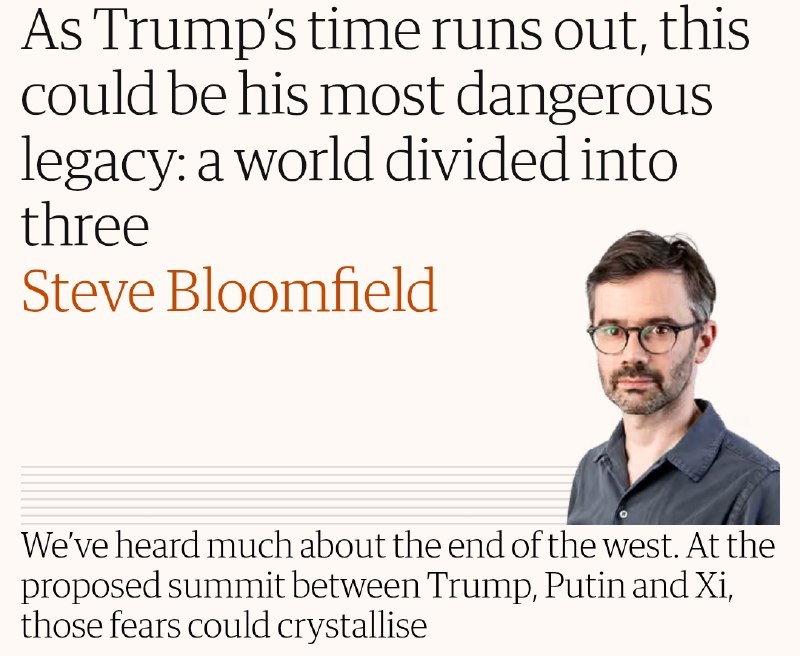
The US, Russia and China can divide the world into spheres of influence. An important step towards this could be the proposed meeting of Trump, Putin and Xi Jinping in China in November, writes the former international editor of the Observer, Steve Bloomfield, in his column for The Guardian. In his opinion, Trump is actually abandoning the previous American policy based on supporting Western allies and opposing the strengthening of Russia and China. Instead, Washington is increasingly leaning toward agreements between great powers, each of which would gain dominant influence in its region. The author draws attention to the US national security strategy published at the end of last year, in which there is almost no criticism of Russia and China, but there are many complaints about Washington's traditional allies in Europe and Asia. Bloomfield in this context is similar to Russia's claims to control the post-Soviet space, and China's claims to control East China and the South China Sea. According to the author, the possible rapprochement of the three powers affects the control of global supply chains, technology platforms, energy resources and space infrastructure. For the US and China, technology and international trade are of particular importance; for Russia, energy resources are of particular importance. All three countries are also interested in controlling space technology, which has both commercial and military significance. Thus, possible agreements between Washington, Moscow and Beijing could change not only the political map of the world, but also the distribution of economic influence. Just ten years ago, the author's secretary, the United States, China, and the European Union were generally considered the three largest power centers. Now in such a structure the place of Brussels is actually taken by Moscow. This scenario is a particular danger for Ukraine and Europe. If the US stops guaranteeing the security of European countries, it will face the threat of increased Russian pressure.
The US, Russia and China can divide the world into spheres of influence. An important step towards this could be the proposed meeting of Trump, Putin and Xi Jinping in China in November, writes the former international editor of the Observer, Steve Bloomfield, in his column for The Guardian. In his opinion, Trump is actually abandoning the previous American policy based on supporting Western allies and opposing the strengthening of Russia and China. Instead, Washington is increasingly leaning toward agreements between great powers, each of which would gain dominant influence in its region. The author draws attention to the US national security strategy published at the end of last year, in which there is almost no criticism of Russia and China, but there are many complaints about Washington's traditional allies in Europe and Asia. Bloomfield in this context is similar to Russia's claims to control the post-Soviet space, and China's claims to control East China and the South China Sea. According to the author, the possible rapprochement of the three powers affects the control of global supply chains, technology platforms, energy resources and space infrastructure. For the US and China, technology and international trade are of particular importance; for Russia, energy resources are of particular importance. All three countries are also interested in controlling space technology, which has both commercial and military significance. Thus, possible agreements between Washington, Moscow and Beijing could change not only the political map of the world, but also the distribution of economic influence. Just ten years ago, the author's secretary, the United States, China, and the European Union were generally considered the three largest power centers. Now in such a structure the place of Brussels is actually taken by Moscow. This scenario is a particular danger for Ukraine and Europe. If the US stops guaranteeing the security of European countries, it will face the threat of increased Russian pressure.