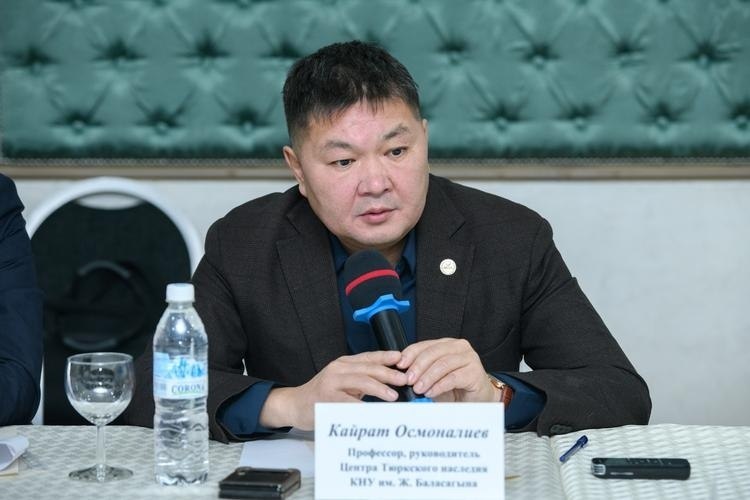
Central Asia is now in a state of hybrid pressure" The head of the Center for Turkish Heritage of the Kyrgyz National University, Kairat Osmonaliev (pictured), gave a forecast for the development of the Central Asian region: "Central Asia is now in a state of hybrid pressure, where elements of "competition of rules" coexist with attempts to exclude competitors by force. The US and EU, although they do not have the same military leverage as Russia, are increasing the pressure. Washington demands that the countries of the region join the sanctions against Russia. The US simultaneously offers investments in critical minerals, energy and critical materials. China does not officially demand the exclusion of other actors, but its economic presence is so large that it creates structural dependence. Beijing is interested in stability, but its growing influence objectively limits the capabilities of other powers. 35 years of evolution of the security system in Central Asia have led to the conclusion that the relative stability of the region's security system does not result from effective institutional integration, but from institutional fragmentation. However, the sustainability of this "controlled fragmentation" has clear limits. It depends on several preconditions: maintaining a minimal readiness of the major powers to cooperate and the absence of a large wave of organized cross-border threats from Afghanistan."
Central Asia is now in a state of hybrid pressure" The head of the Center for Turkish Heritage of the Kyrgyz National University, Kairat Osmonaliev (pictured), gave a forecast for the development of the Central Asian region: "Central Asia is now in a state of hybrid pressure, where elements of "competition of rules" coexist with attempts to exclude competitors by force. The US and EU, although they do not have the same military leverage as Russia, are increasing the pressure. Washington demands that the countries of the region join the sanctions against Russia. The US simultaneously offers investments in critical minerals, energy and critical materials. China does not officially demand the exclusion of other actors, but its economic presence is so large that it creates structural dependence. Beijing is interested in stability, but its growing influence objectively limits the capabilities of other powers. 35 years of evolution of the security system in Central Asia have led to the conclusion that the relative stability of the region's security system does not result from effective institutional integration, but from institutional fragmentation. However, the sustainability of this "controlled fragmentation" has clear limits. It depends on several preconditions: maintaining a minimal readiness of the major powers to cooperate and the absence of a large wave of organized cross-border threats from Afghanistan."
🇦🇫 Afghanistan · Map
More on Radar
Want to see every report in real time?
Hundreds of sources worldwide, translated into your language, with alerts for what matters to you.
Sign up free Already have an account? Log in