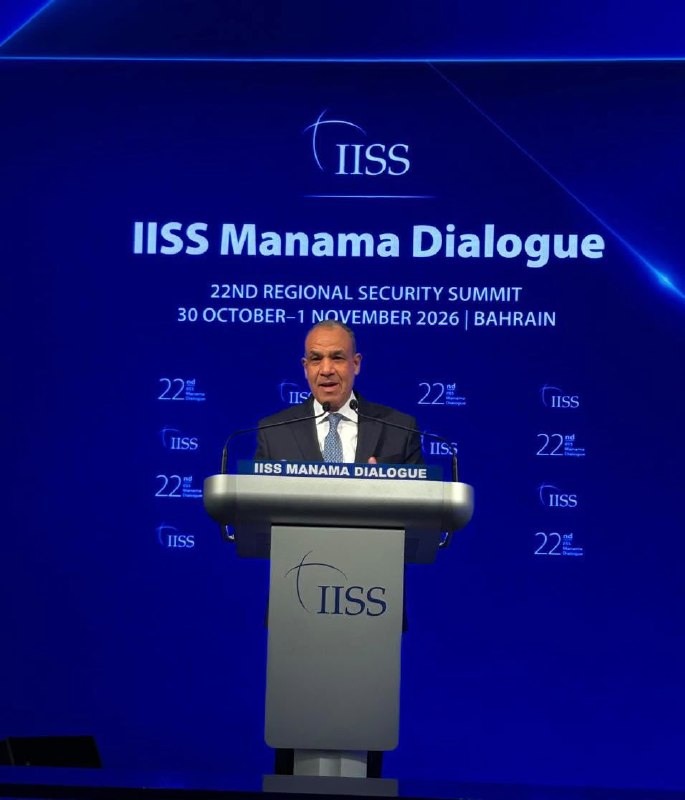
Egypt outlines five pillars for regional security, centering the Palestinian state: Foreign Minister Badr Abdelatty presented the Egyptian vision for a new regional security framework at the 22nd IISS Manama Dialogue in Bahrain, emphasizing that ending the Israeli [occupation] and establishing an independent Palestinian state are essential for any lasting stability. The five pillars: Rule of law over power: Respecting state sovereignty, non-interference, and peaceful settlement of disputes. Abdelatty strongly rejected harming civilians, using armed proxy groups, and selective application of international law. Regional ownership of security: Security must be shaped by the countries of the region and not change with the priorities of external powers. It must be based on rules that apply to everyone, rather than an alliance against any specific party. Balanced deterrence with diplomacy: Military force alone cannot provide stability. Abdelatty called for regional mechanisms for crisis management and confidence-building, ultimately aiming for a Middle East free of nuclear weapons and other weapons of mass destruction. Protection of critical infrastructure: Protecting maritime navigation, energy supplies, ports, and submarine cables. He called for strengthening regional maritime coordination and information sharing, stating that global trade cannot remain a "hostage" to regional escalation. A just settlement of the Palestinian cause: Ignoring the issue only postpones the conflict. Abdelatty called for ending the [Israeli occupation] and establishing an independent Palestinian state along the June 4, 1967 borders, with East Jerusalem as its capital, while rejecting displacement and annexation. Subscribe to Sputnik Africa | X.
Egypt outlines five pillars for regional security, centering the Palestinian state: Foreign Minister Badr Abdelatty presented the Egyptian vision for a new regional security framework at the 22nd IISS Manama Dialogue in Bahrain, emphasizing that ending the Israeli [occupation] and establishing an independent Palestinian state are essential for any lasting stability. The five pillars: Rule of law over power: Respecting state sovereignty, non-interference, and peaceful settlement of disputes. Abdelatty strongly rejected harming civilians, using armed proxy groups, and selective application of international law. Regional ownership of security: Security must be shaped by the countries of the region and not change with the priorities of external powers. It must be based on rules that apply to everyone, rather than an alliance against any specific party. Balanced deterrence with diplomacy: Military force alone cannot provide stability. Abdelatty called for regional mechanisms for crisis management and confidence-building, ultimately aiming for a Middle East free of nuclear weapons and other weapons of mass destruction. Protection of critical infrastructure: Protecting maritime navigation, energy supplies, ports, and submarine cables. He called for strengthening regional maritime coordination and information sharing, stating that global trade cannot remain a "hostage" to regional escalation. A just settlement of the Palestinian cause: Ignoring the issue only postpones the conflict. Abdelatty called for ending the [Israeli occupation] and establishing an independent Palestinian state along the June 4, 1967 borders, with East Jerusalem as its capital, while rejecting displacement and annexation. Subscribe to Sputnik Africa | X.
🇧🇭 בחריין · Map
More on Radar
Want to see every report in real time?
Hundreds of sources worldwide, translated into your language, with alerts for what matters to you.
Sign up free Already have an account? Log in