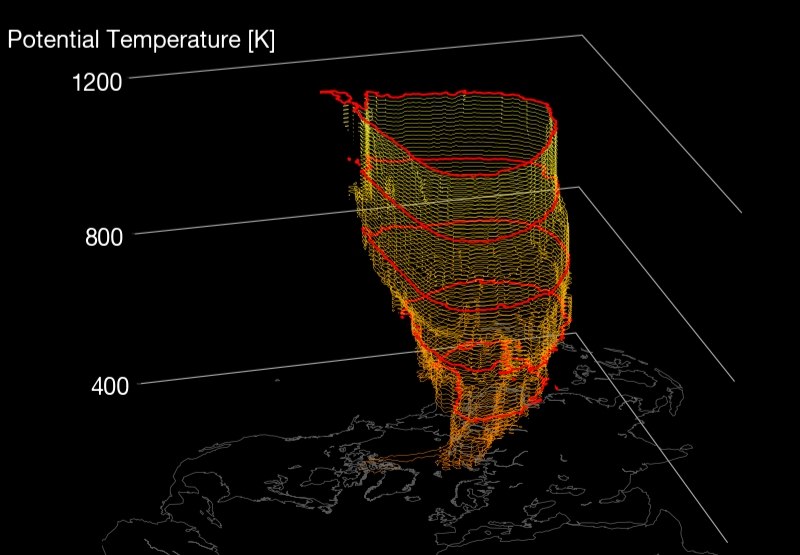
How tall are cyclones?
We often hear and read in the weather reports that a cyclone has formed over a certain area, associated with certain weather changes. Moreover, in some cases it is noted that the cyclone formed in the atmosphere can be traced to high altitudes and therefore long-term weather anomalies may be associated with it. The question arises: how is the height of the cyclone determined and to what heights do they reach?
Studies of cyclones, as well as anticyclones and other synoptic objects are currently carried out using a variety of methods. Already in the 1930s, thanks to the practical introduction of meteorological observations, invented by the outstanding Soviet scientist P.A. Molchanov's radiosonde provided systematic measurements of temperature, wind and other atmospheric parameters up to altitudes of 25-30 km.
When analyzing synoptic maps constructed from radio sounding data, meteorologists discovered that isobar curves caused by cyclones can be seen not only in the receptive layer of the atmosphere, but even at heights of tens of kilometers. It has been observed that low cyclones (those reaching heights of less than 3 km) tend to cover a small area and are the least durable. The higher the cyclone, the more extreme and long-term weather changes it brings, and the larger the area it covers.
Significant progress in measuring meteorological parameters at high altitude has been made possible based on rocket methods. Soviet scientists made a great contribution to the creation of these methods. An analysis of synoptic maps for levels of 30-70 km, constructed from rocket measurements, showed that cyclones and anticyclones are also observed at these heights, which in some cases are a direct continuation of the corresponding synoptic formations at heights of less than 30 km.
However, it is also possible that there was an anticyclone above the low cyclone, which in turn was replaced by a cyclone as the height increased.